
Does this kill your sale? Is insurance about to become a problem? Do you have to spend thousands of dollars before you can move forward? Those are the real questions running through your head right now, and the short answer to all three is: not necessarily.
A wind mitigation failed inspection in Florida usually means your home didn’t document enough storm-resistant features to qualify for certain insurance discounts. It doesn’t mean the house is uninsurable, unsafe, or unsellable. It just means a little less savings on your premium until something changes, or it means you have a few paths to choose from.
This guide walks through what a failed inspection actually means, what it can cost you if you ignore it, what fixing it really involves, and what your options are if repairs feel like more time and money than you want to put in.
If that last part sounds like you, we’ll also talk about selling the house as-is to a cash buyer like The Best Cash Home Buyer, no repairs, no re-inspection, no waiting on a buyer’s insurance agent to sign off. This is educational, not legal or insurance advice.
Wind mitigation is mainly about proving your home has features that hold up well in a storm, things like a reinforced roof, hurricane shutters, or impact windows, and getting that documented so your insurer can apply a discount. The form they use is called the OIR-B1-1802, but you don’t need to memorize that, your inspector handles the paperwork.
Florida doesn’t require homeowners to get this inspection. But if you do get one and your home qualifies, insurers are required to apply the discount. That’s the whole point of the exercise, lower your premium by proving your house can take a hit from a hurricane.
Here’s the part worth repeating: a wind mitigation failed inspection does not mean your home is worthless or unsellable. It usually just means the home doesn’t qualify for certain insurance discounts right now, not that something is fundamentally wrong with it.
That said, it can still create a few headaches:
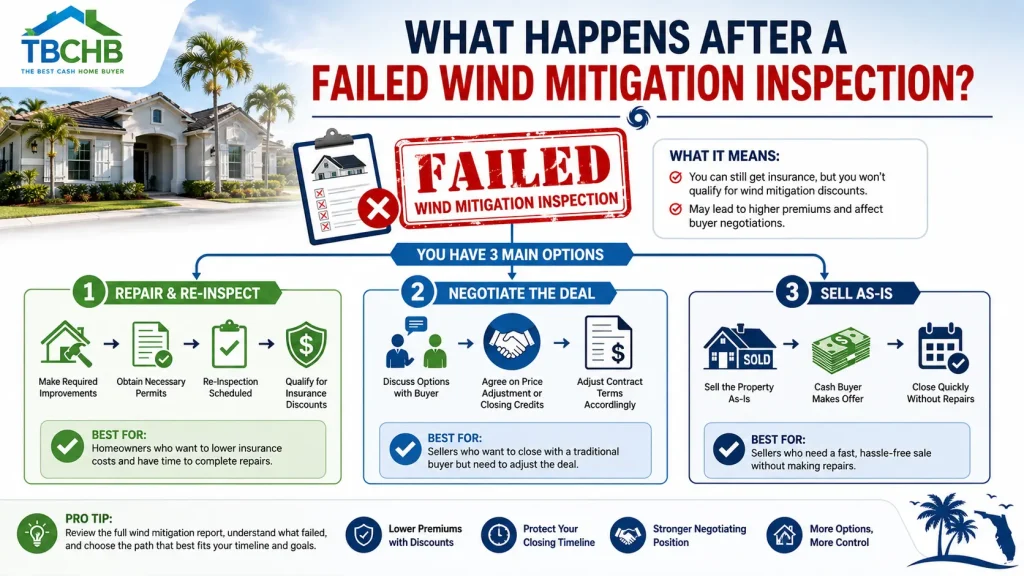
From here, you’ve basically got three paths: fix it and get re-inspected, adjust the deal to reflect where things stand, or skip the whole process and explore other ways to sell. We’ll walk through all three.
A failed inspection can ripple into a few different parts of the sale, and it’s worth seeing the full picture before you decide what to do.
Your insurance premium: Without the discount applied, you’re paying more month to month than you would otherwise. How much more depends on your insurer and policy, your agent can tell you which specific upgrades would move the needle most.
Lender comfort: A failed wind mitigation won’t block a buyer from getting coverage, but if it pushes their premium up significantly, a lender reviewing affordability may take a closer look during underwriting. That’s one more place a deal can slow down, especially for buyers financing the purchase with a mortgage.
Your sale price: Buyers tend to respond in one of three ways: ask you to make the repairs, ask for a credit to cover their higher insurance costs, or ask for a lower price outright. None of these are guaranteed outcomes, but they’re common enough that you should expect the conversation, not be blindsided by it.
This is exactly the kind of friction, premium surprises, lender pushback, price haggling, that piles up in a traditional sale. It’s also exactly the kind of friction a cash sale tends to skip past entirely, since there’s no lender combing through your insurance numbers and no buyer waiting on a discount to make the math work for them.
If you want to chase the discount, here’s the real version of what that looks like, not the brochure version:
For some homeowners, this is exactly where the process starts feeling like more trouble than it’s worth. Quotes, permits, scheduling, waiting on contractor availability, and then waiting again for a re-inspection slot, it adds up to weeks or months, not days. There’s no shame in looking at that list and deciding it’s not the route you want to take.
Once repairs are done, you’ll need a fresh wind mitigation inspection to confirm everything now qualifies. It’s a doable step, but it is another appointment, another person walking your property, and another stretch of waiting before the paperwork updates with your insurer.
Before that visit, make sure your attic is accessible, your windows and doors aren’t blocked, and all your documentation, invoices, permits, photos, is ready to hand over. If you’re already feeling the weight of one delay after another in this process, that feeling is a pretty good signal that a faster, simpler path might be worth considering.
Quick version: a 4-point inspection looks at the age and condition of your roof, electrical, plumbing, and HVAC, mainly to confirm the home is insurable at all. Wind mitigation is a separate thing entirely, it’s about whether your home qualifies for storm-related discounts. Failing one doesn’t automatically mean you fail the other, but issues on either report can slow down underwriting and closing, so it’s worth knowing both exist.
There’s no flat statewide number for wind mitigation repairs, it depends entirely on what failed and how much work it takes to fix. But here’s the honest version: if the issue involves your roof, your openings, or structural connections, costs can climb fast. Get at least three written quotes, make sure labor and materials are broken out separately, and ask each contractor to confirm exactly which wind-mitigation criteria their work addresses.
Before you commit real money to any of this, it’s worth pausing to ask whether the repair cost actually gets you where you want to go, or whether selling the house as-is and skipping the contractor bill entirely might get you there faster and for less out-of-pocket.
If you do plan to list the home the traditional way, getting ahead of this matters. A pre-listing walkthrough with a contractor familiar with wind mitigation criteria can flag problems before a buyer’s inspector finds them, which keeps you in control of the conversation instead of reacting to it under contract.
But if the home already has known issues and spending money to fix them isn’t something you want to do, that’s a completely fair place to land, and it points toward a different kind of sale entirely.
If repair costs or timelines feel like too much, here’s what’s actually on the table:
Repair and sell traditionally: Fix the deficiencies, pass the re-inspection, and move forward with a normal sale where insurance numbers are already settled.
Sell as-is to an informed buyer: Price the home to reflect the open items, disclose everything, and let an experienced buyer, often an investor, take on the repairs themselves.
Sell as-is to a cash buyer: This is where most of the hassle disappears. Cash buyers generally don’t require lender-driven repairs, they’re used to working with homes that have open inspection items, and they can move on a timeline that actually works for you. Take a look at how a cash sale typically works to see just how much shorter the process can be. You skip the contractor quotes, skip the re-inspection appointment, skip the back-and-forth over credits, and skip the lender second-guessing your insurance numbers.
For sellers who just want this whole process behind them, this option tends to feel like the relief valve in the middle of a lot of moving parts. It trades a bit of negotiating leverage for speed and certainty, and for a lot of people in this exact situation, that’s a trade worth making.
If you do go the traditional route, it helps to know what’s coming. Buyers will likely ask for the full wind mitigation report, get their own contractor quotes, check with their insurance agent about what their premium looks like without the discount, and then decide whether to push for repairs, a credit, or a lower price. That’s a lot of moving parts working against you in a negotiation, and it’s exactly why a cash sale, which sidesteps most of that back-and-forth, appeals to so many sellers in this spot.
Are wind mitigation inspections required in Florida?
No. They’re optional, but if you get one and your home qualifies, your insurer is required to apply the discount under Florida Statute §627.0629.
What do inspectors actually look at?
Mainly your roof-to-wall connections, your openings (windows, doors, shutters), and your roof covering. You can find a more detailed breakdown through the Florida Office of Insurance Regulation’s wind mitigation resources.
How long does the inspection take?
It depends on the size and complexity of the home. Ask your inspector for a window before scheduling, especially if you’re working around a closing date.
Can I still get homeowners insurance after a failed inspection?
Yes. It usually affects your discount eligibility, not whether you can get coverage at all.
Is it worth fixing the deficiencies before selling?
Depends on the cost, your timeline, and how the market’s moving. Repairs can boost buyer confidence and insurance savings, but selling as-is can be the better call when the cost or time just doesn’t pencil out for you.
Can I sell my Florida house after a failed wind mitigation inspection?
Yes. You don’t need to fix anything first. Selling as-is to a cash buyer like The Best Cash Home Buyer means skipping repairs, re-inspections, and the closing delays that often come with the traditional route.
A wind mitigation failed inspection is a common situation for Florida homeowners, and it doesn’t have to end your sale or derail your plans. What matters is understanding what the result actually means, knowing your repair options, and being honest with yourself about whether that path fits your timeline and budget.
If it doesn’t, here’s the relief: The Best Cash Home Buyer buys Florida homes as-is, open wind mitigation items and all. No repairs, no re-inspection appointments, no waiting on a buyer’s insurance agent, no commissions, and most closing costs covered. They typically close in as little as 14 days, or on whatever timeline actually works for you. Take a look at how the process works, or reach out for a no-obligation cash offer at thebestcashhomebuyer.com, call (727) 291-9712, or email Offers@thebestcashhomebuyer.com.
