

A Florida owner or fix-and-flip operator can receive a restoration bid after a ceiling leak and still not know whether the number ends at drying or includes the work needed to make the house saleable. Come to think of it, the answer to how much water damage repair costs in Florida is that no authoritative statewide repair-cost benchmark was verified as of July 2026.
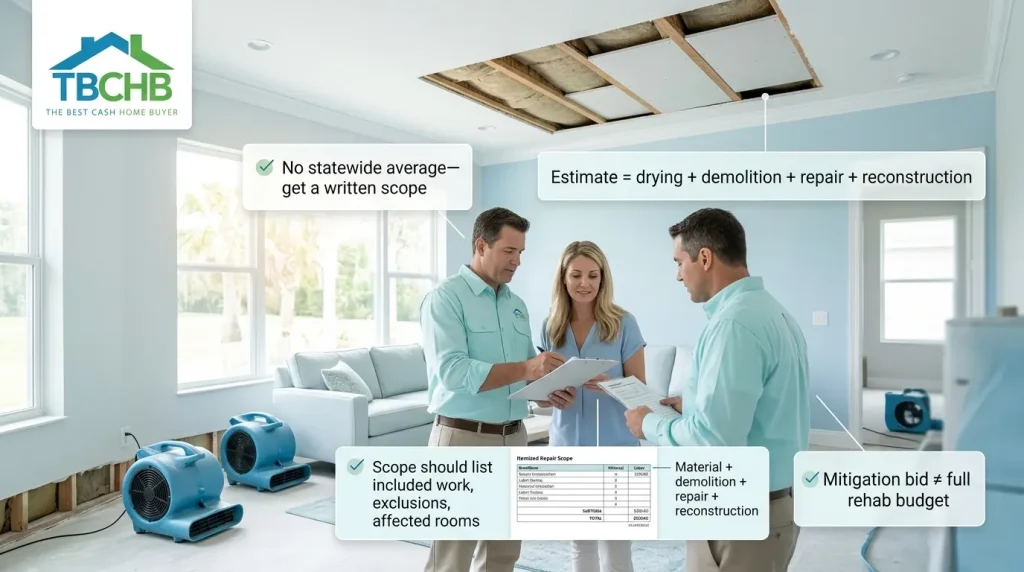
A responsible estimate starts with a property-specific written scope that separates drying, demolition, repair, and reconstruction. Those phases can appear in one proposal, separate proposals, or not at all. That distinction matters more than an unsupported statewide average because a drying quote, a contractor repair estimate, an insurance payment, and a complete rehab budget measure different things.
For an owner deciding whether to repair or sell and for an investor underwriting a possible acquisition, the useful question is not which online number applies to every Florida property. It is which work is included, what remains unknown, and how the complete scope fits the intended exit.
An investor may hear one number from a contractor and a different number from an insurer, while neither document says whether reconstruction is included. No authoritative Florida statewide water-damage repair-cost benchmark was verified as of July 2026, so a property-specific written scope is the sound basis for estimating the work.
Online figures often conflict because they may combine different phases of a loss, property sizes, materials, and damage scenarios. A number describing extraction and drying does not necessarily include demolition. A demolition scope does not necessarily include replacement flooring, cabinets, ceilings, or finish work.
An insurance payment is also not a repair-cost benchmark because it measures claim payment, not the total work required to restore or reposition the property. The Insurance Information Institute notes that water damage and freezing are among the most common homeowners insurance claims, but coverage and payout still depend entirely on the specific policy and cause of loss.
The estimate is only as useful as the scope behind it.
| Water removal | Is removal included, or is this quote limited to later work? |
| Drying | Does the scope identify the rooms and materials being dried? |
| Demolition | Which materials are being removed, and from which rooms? |
| Repair | Does the quote include repair of damaged surfaces or systems? |
| Reconstruction | Does it include rebuilding and replacement after removal? |
Before relying on any number, request a written scope that lists included work, exclusions, assumptions, affected rooms, and whether the proposal ends at drying or includes reconstruction. That document gives an owner or buyer something concrete to compare across bids and against the intended property decision.
This is the same discipline worth applying before you ever schedule a home inspection in Florida — know what a report actually covers before you price a repair off of it.
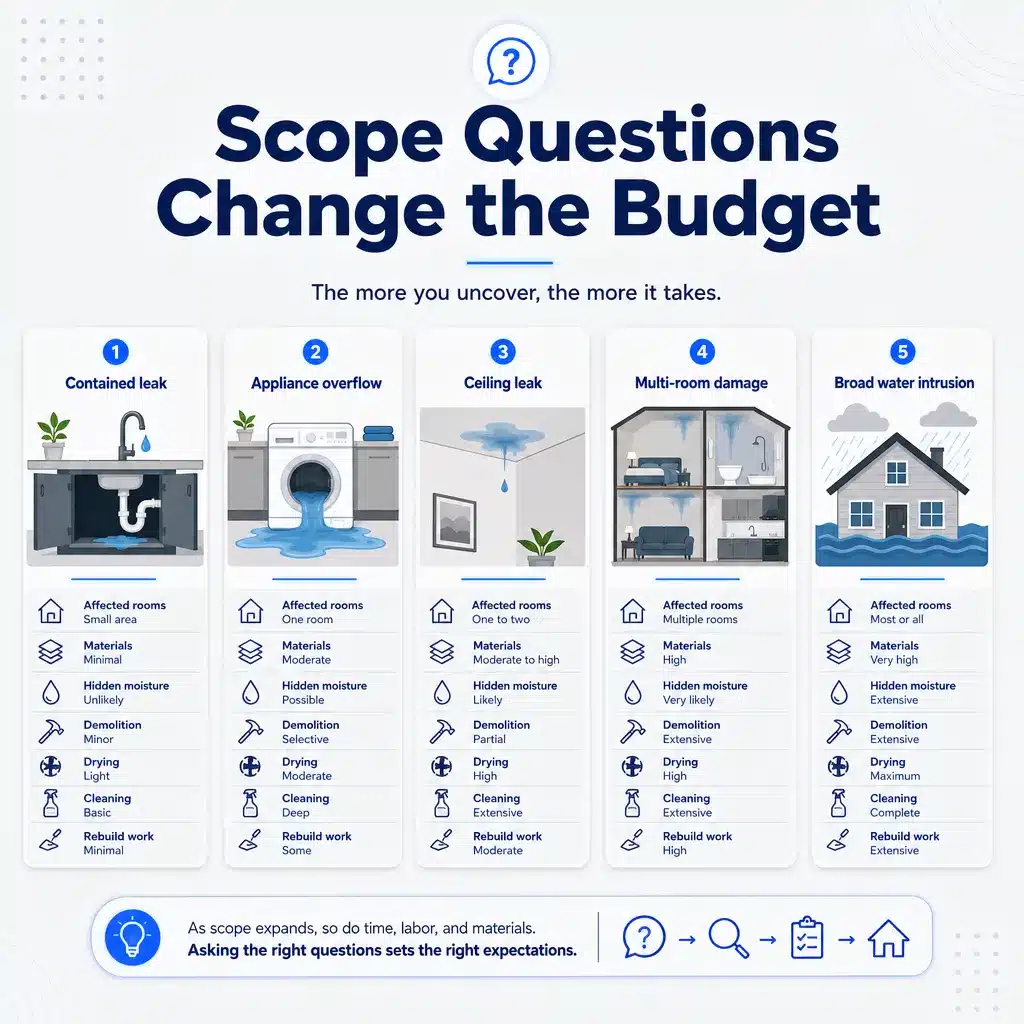
A Florida flipper may treat a bathroom leak as paint and drywall work, then find the estimate changes once the ceiling below and flooring behind the vanity are part of the scope. Scenario-based budgeting is more useful than a flat Florida average because the work mix changes with the event and the materials affected.
Use the scenario to organize questions, not to assume a price.
| Contained leak | Which room is affected, what materials show damage, and does the scope include drying, removal, and repair? |
| Appliance overflow | Did water reach adjacent rooms, flooring, cabinets, walls, or lower-level ceilings? |
| Ceiling or upper-floor leak | Does the scope include the source area, the ceiling below, insulation, flooring, and rebuild work after demolition? |
| Multi-room damage | Which rooms are included, what materials are affected, and where does the written scope stop? |
| Broad water-intrusion event | What are the affected areas, hidden-moisture assumptions, cleaning or treatment scope, demolition needs, and reconstruction requirements? |
Mark every affected room before comparing bids. Then ask whether walls, flooring, ceilings, cabinets, insulation, or subflooring are included in the written scope. A proposal that names the event but not the rooms and materials leaves too much of the budget unresolved.
A damage label does not describe a complete rehab scope.
A wholesaler may hear that a leak was small, then see damaged flooring near one room and a stained ceiling below another during the walkthrough. The repair estimate depends on the complete property-specific scope, not only on what is visible at the source.
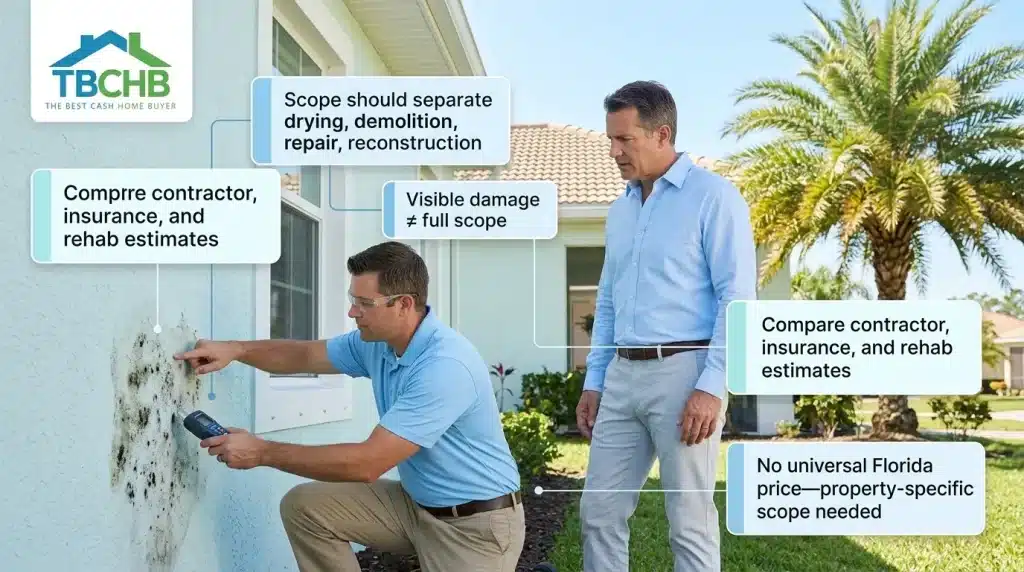
Visible damage is not automatically the full scope. Ask the contractor to identify assumptions, excluded rooms, and whether moisture behind walls, under flooring, or above ceilings has been evaluated.
Restoration contractors that follow the IICRC S500 water damage restoration standard are generally working from a recognized inspection and documentation framework, which is worth asking about when you compare bids.
Rough inputs are not a decision system when hidden scope can change the deal. We apply the same operating principle to growth work: operators need a managed process that keeps them focused on acquisitions rather than another platform or dashboard to run.
A fix-and-flip operator may have a low drying quote in hand but still be unable to tell whether the property budget covers replacement of materials removed to expose the damage. A mitigation bid is not automatically a full rehab budget.
Use a written, itemized scope to compare stated work, omissions, assumptions, and whether mitigation, repair, and reconstruction are included before making a property decision. A verbal ballpark cannot show where one phase ends and another begins.
A line-item scope turns an estimate into an underwriting document. Operators do not need more generic estimates. They need a method that separates visible repair from decision-critical unknowns, just as they need growth work handled without taking attention away from acquisitions.
An owner may see an insurance payment discussed as if it settles the repair budget while the contractor scope still leaves rebuilding work unclear. An insurance payment is not automatically the repair budget.
Claim outcomes depend on the actual policy, exclusions, deductible, limits, documentation, and insurer determination. This article does not establish whether a particular water event is covered, excluded, or subject to any specific policy treatment.
Florida’s Department of Financial Services provides consumer resources on how homeowners insurance claims are supposed to be handled if a dispute comes up, and its Division of Consumer Services can also field complaints about a claim. Some carriers also factor in a property’s wind mitigation inspection results when pricing or renewing a policy, which is worth knowing before a claim is even filed.
| Contractor repair estimate | The work stated in the contractor’s scope | Which rooms, materials, phases, exclusions, and assumptions are listed? |
| Insurance payment | Claim payment under the applicable policy and insurer determination | Which claimed work does the payment address, and what work remains unclear? |
| Full rehab budget | The total work and risk required for the chosen exit | Does it include mitigation, repair, reconstruction, unresolved scope, and finish expectations? |
The same property can produce different numbers because the scope behind each number differs. Compare the contractor’s line items with the claim scope and identify work that is not addressed before deciding whether to repair, continue a claim process, or sell.
A reported number has little value without the mechanism and scope behind it. We use that same discipline in marketing measurement, focusing on measurable visibility and original market-specific assets rather than reporting a surface metric without explaining what produced it.
An investor comparing a Jacksonville contractor estimate to a Southwest Florida online price table may realize that neither document describes the same repair scope. A city-specific contractor price or online article should not be treated as a statewide Florida rule.
Property configuration, local access, contractor scope, finish level, water source, duration, and affected materials can make one estimate unlike another. Compare the same scope fields across bids:
Comparable bids describe comparable work. If one proposal includes only drying and another includes removal, repair, and rebuild work, the totals do not answer the same question.
A Florida owner with limited cash for an unknown rebuild may need to decide whether more contractor management improves the outcome enough to justify the execution risk. No path is universally best, because the decision depends on scope certainty, capital, management burden, claim status, exit objective, and tolerance for unresolved work.
Write down the complete scope, remaining unknowns, available capital, and exit objective before choosing a path.
| Repair before sale | How certain is the complete scope, how much capital is available, what management burden is acceptable, and does the expected finish match the exit objective? |
| Insurance-led repair path | What does the contractor scope include, what does the claim process address, what remains outside the identified work, and how much timing uncertainty can the owner accept? |
| As-is sale | Does avoiding additional contractor management fit the owner’s capital position, scope uncertainty, timing needs, and execution tolerance? |
The better path is the one that matches the complete scope and the owner’s operating capacity, not the lowest isolated bid. A cash offer can be one comparison option when scope certainty, capital, or management burden does not fit the owner’s plan — see our overview of selling a house as-is in Florida for how that process typically works. It is not automatically a better outcome, and it should be evaluated against the other available paths.
A wholesaler may have photos of a stain but no scope showing included work, making it difficult to support a repair deduction with an end buyer. The fastest way to improve a water-damage estimate is to organize comparable written evidence before assigning a repair number.
A useful written scope states included work, excluded work, assumptions, affected rooms, and whether reconstruction is included. Evidence that is organized and comparable supports a stronger property decision than scattered verbal estimates.
We apply the same operating discipline to visibility work by tracking what is actually happening rather than asking operators to manage another tool.
A reader may search for one Florida number, then realize the useful answer is a method for telling whether a quote covers the work the property actually needs. We do not publish an unsupported statewide average, insurance-payout figure, universal timeline, or policy promise.
The useful estimate is the one that explains the work, not merely the one that supplies a total.
Water damage repair costs in Florida cannot be responsibly reduced to one statewide number without verified methodology and a shared scope of work. The practical approach is to separate mitigation, demolition, repair, reconstruction, insurance payment, and full rehab budgeting into distinct questions.
With an itemized scope, an owner or investor can compare bids, identify unresolved risk, and choose a repair, claim-related, or disposition path based on the property rather than a generic average.
No authoritative Florida statewide average was verified in the available fact packet as of July 2026. The more useful estimate is a written, property-specific scope that separates drying, demolition, repair, and reconstruction. Do not rely on a statewide dollar range if the work included in that range is unclear.
No verified Florida-average insurance payout figure is available in this packet. An insurance payment is a different metric from a contractor repair estimate and a complete rehab budget. Compare what each document actually addresses before using either number in a property decision.
It depends on the actual policy, exclusions, deductible, limits, documentation, and insurer determination. We cannot make a coverage promise or state categorical Florida policy rules without verified official sources. Review the applicable policy and compare the claim scope with the contractor’s written scope. The Insurance Information Institute has general background on how homeowners policies typically treat water losses, which is a useful starting point before contacting an agent.
Not necessarily. Confirm whether the quote includes drying, demolition, repair, replacement materials, and rebuilding. A mitigation-only scope may not represent the full rehab budget or the work needed for the intended exit.
It can, but the decision depends on the complete written scope, unresolved risks, available capital, intended exit, and execution tolerance. Underwrite the whole scope rather than deducting from an asking price based on a verbal ballpark or a generic online figure.
