
Picture yourself doing the math at 11 p.m. on another mortgage payment, insurance bill, and lawn visit for a Tampa house nobody is using. That slow monthly drain is exactly why most owners of vacant properties feel stuck between selling fast and selling smart.
Selling a vacant house in Tampa is possible regardless of condition — but carrying costs and risk change which path actually makes sense. This guide covers the real monthly costs of vacancy, your pricing options, prep steps, legal requirements, security basics, and when a cash home sale beats a traditional listing for an empty Tampa property.
An empty home does not sit still — it drains money and accumulates risk simultaneously. Buyers are also more skeptical of vacant properties: without furniture, every flaw is center stage, and listing photos can feel cold and uninviting. Some buyers interpret vacancy as a sign the seller is motivated and open to aggressive low offers.
The financial case for acting promptly is straightforward. Every extra week on the market means more bills and more exposure to Tampa’s climate hazards — AC failures, humidity buildup, roof leaks, and storm damage that nobody catches in time. Summer in Florida is particularly unforgiving to an unmonitored property.
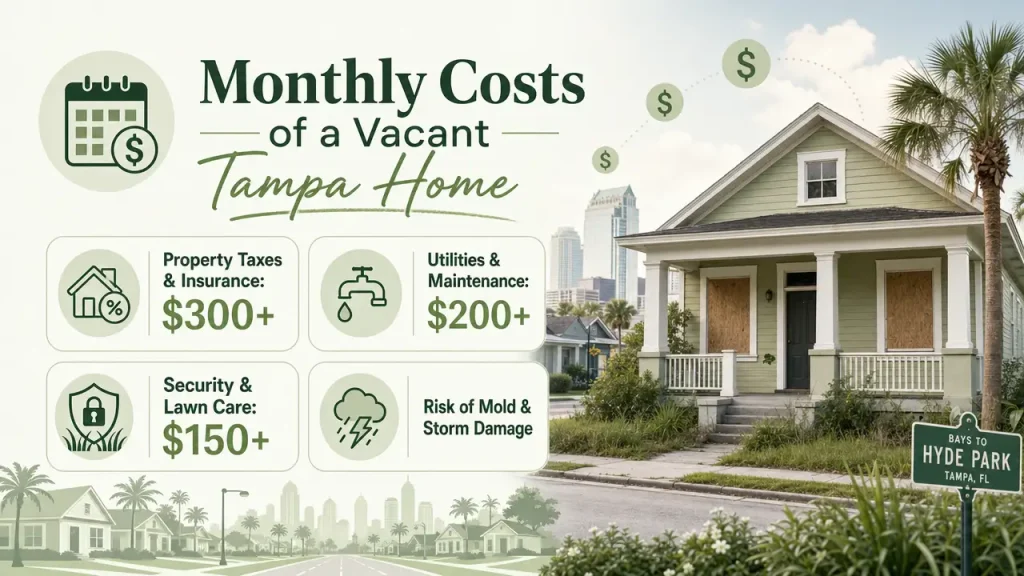
For many Tampa owners, taxes, insurance, and basic utilities alone run several hundred dollars a month before any maintenance. Add lawn, pool, and pest control and the meter keeps running — which is why the net you actually keep matters far more than the headline list price. Vacancy does not mean your house will not sell — it means every extra week costs real dollars and adds compounding risk.
| Cost Category | Examples | Risk if Ignored |
| Ownership costs | Property taxes, homeowner’s insurance, HOA dues | Liens, coverage lapses |
| Utilities | Electric (AC), water, basic service | Mold, burst pipes, code issues |
| Maintenance | Lawn, pool service, pest control | Code fines, curb-appeal damage |
| Security | Alarm, cameras, periodic check-ins | Break-ins, copper theft, squatters |
Pricing an empty Tampa home means choosing between maximum price with maximum effort, or a faster exit with less upfront spending. Appraisers do not automatically discount for vacancy, but condition and days-on-market both move the final number in ways that hurt sellers who wait too long.
The right lane depends on your available budget for repairs, your timeline tolerance, and how much additional carrying cost you can absorb while waiting for the right financed buyer.
• Full retail on the MLS — targets top-of-market buyers; requires repairs, staging, and agent commissions; best when the property is in solid shape and you can comfortably wait several months for the right offer
• As-is MLS listing — honest pricing with repair credits built in; still involves showings, inspections, and potential lender or appraisal pushback on condition
• Direct as-is cash sale — no lender, no appraisal, no repairs required; buyer prices condition and risk into the offer; fastest path to stopping the vacancy meter entirely
A cash offer is not automatically a financial loss. If a slightly higher MLS price takes three to four months, and during that time you are still covering taxes, insurance, lawn, pool service, and unexpected repairs, your net proceeds may land in the same place — or lower — compared to a clean cash offer accepted today.
Our guide on selling a house as-is in Florida explains how as-is pricing works and what sellers typically net after all transaction costs. Knowing both numbers before you decide is the best way to avoid leaving money on the table either direction.
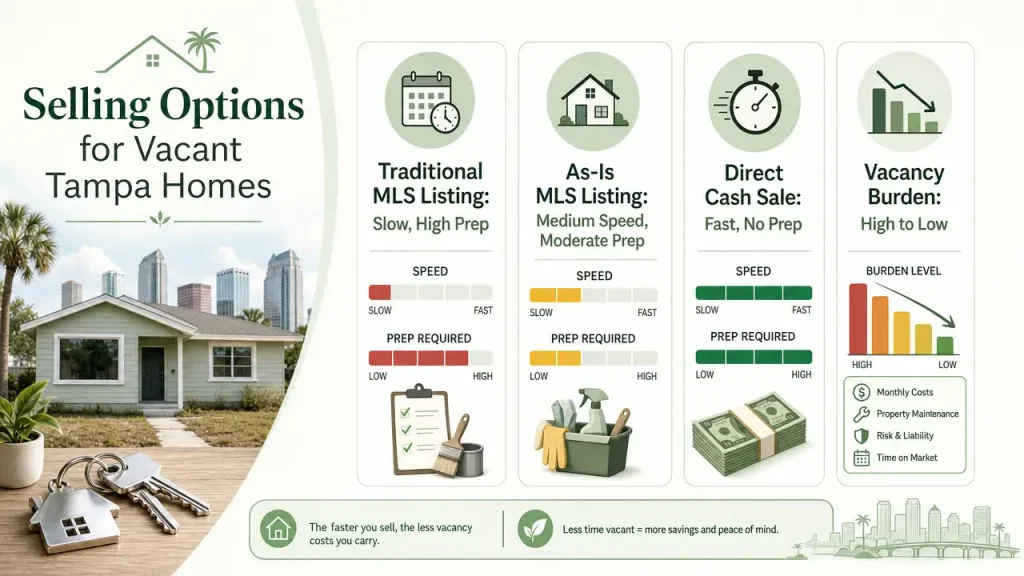
An empty home photographs and shows worse than an occupied one. Buyers struggle to gauge room size without reference points, every surface defect is visible, and the house can feel abandoned rather than available. A few targeted moves address these problems without a large renovation budget.
Focus on what buyers and cameras actually see — the entry, main living space, primary bedroom, and yard. Everything else has a negligible impact on the offers you receive.
| Task | Why It Matters | Budget Level |
| Deep clean + odor control | Musty smell kills showings instantly in Florida humidity | Low |
| Lawn mow, edge, trim | Curb appeal is the first impression in photos and drive-bys | Low |
| AC set to 78–80°F | Prevents mold; keeps air moving so the house smells neutral | Low |
| Minimal furniture in key rooms | Helps buyers judge space; photos look lived-in | Medium |
| Smart lock + camera doorbell | Remote access for showings; deters theft and squatters | Medium |
| Clear mail, flyers, standing water | Removes visible signals the house has been long-ignored | Low |
If budget is tight, the deep clean, lawn care, and AC management alone address the most common buyer objections to vacant Tampa homes. If the house needs a major cleanout or you live out of state, an as-is cash buyer handles all prep after closing with no work required from you beforehand.
Vacancy does not reduce your disclosure obligations in Florida. Sellers must disclose known material defects that affect value or safety, and an empty house often makes issues more visible rather than easier to hide. Patched walls, stained ceilings, and evidence of prior water intrusion stand out without furniture to soften the view.
Key disclosure areas for vacant Tampa properties include flood zone status, prior water or mold damage, sinkhole history, storm damage, and structural or electrical concerns. For homes built before 1978, federal lead-based paint disclosure rules require additional paperwork regardless of whether the property is currently occupied.
Insurance is a separate and important concern. Many standard homeowner policies change terms or reduce coverage once a home has been vacant for 30 to 60 days. Call your insurer before listing to confirm exactly how vacancy affects your policy — do not assume terms remain unchanged.
• Flood zone and prior water history — required disclosure; buyers and lenders verify FEMA flood maps independently during due diligence
• Sinkhole activity or prior repair — must disclose known history; Florida law requires specific disclosures on residential sales
• Code enforcement liens — overgrown yard, green pool, or visible debris can generate fines that attach to title and must be resolved before closing
• Probate and title complications — inherited vacant properties often carry title issues; a Florida real estate attorney can identify and resolve these problems early
This section is general educational information, not legal advice. For inherited properties, squatter situations, active code violations, or complex title questions, a short consult with a qualified Florida attorney is worth the time and cost.
Each selling path carries a different tradeoff between maximum net price, speed to close, and how much of the ongoing vacancy burden you absorb during the process. Condition, location, and your personal capacity to manage the transaction all determine which route is realistic for your situation.
| Option | Speed | Prep Required | Vacancy Burden | Complexity |
| Agent / MLS | Slow (months) | High — repairs, staging | High — bills keep running | High |
| FSBO | Slow | High — you manage all of it | High — plus every logistic | Highest |
| iBuyer | Medium | Moderate — decent condition | Medium — some delay | Medium |
| Local cash buyer | Fast (days–weeks) | None — buys as-is | Low — stops at closing | Low |
Traditional listings still produce the best net when a home is in good shape, you live nearby, and holding costs are not a financial strain. For out-of-town owners or properties needing significant work, the math regularly favors speed and certainty over a higher headline price. Selling without a realtor in Florida is possible, but managing showings, contracts, and vendor coordination remotely on a vacant property is rarely as simple as it sounds.
Tampa’s heat, humidity, and active hurricane season make vacancy riskier than in most US markets. A small roof leak or AC failure can produce significant mold damage within weeks when no one is checking the property. Code enforcement can issue fines for an overgrown yard or green pool before the seller even receives notice.
A basic security and maintenance routine reduces these risks while keeping the property in showing-ready condition throughout the listing period.
• Re-key locks and add a smart lock — control showing access remotely without being on-site for every appointment
• Install a monitored camera or doorbell — deters break-ins and copper theft; alerts you to problems before they become expensive
• Forward or stop mail — accumulated mail signals vacancy to would-be trespassers and thieves in the area
• Weekly walk-through by a local contact — a neighbor or handyman catches leaks, storm damage, and pest activity before costs compound
• Maintain pool and lawn service — prevents code violation letters and liens that attach to title and complicate your closing
• Hurricane preparation — trim overhanging limbs, secure outdoor items, verify shutters or impact windows are functional before storm season
Every one of these tasks has a recurring cost on top of your baseline taxes, insurance, and utilities. That accumulated monthly spending is a primary reason many vacant-home owners ultimately choose a cash sale — once closing happens, the buyer immediately takes over all security and maintenance responsibility.
Listing with a good agent can still produce the best net when the home is in solid condition, you can cover carrying costs without financial stress, and you have the bandwidth to manage showings, inspections, and potential repair negotiations from wherever you are.
A cash sale tends to be the better fit when the opposite conditions apply. Four questions help clarify which direction fits your situation:
• Are you under time pressure? — dual mortgage payments, a relocation deadline, or probate timelines all shift the equation toward speed and a guaranteed close date
• Do you live far from the property? — managing vendors, showings, and inspections remotely on a vacant home adds real cost and stress that erodes the price advantage of listing
• Does the house need significant work? — repair costs and lender hesitation over condition close the gap between cash and retail faster than most sellers anticipate
• Are title, probate, or code issues involved? — inherited vacant homes in Florida and properties with active code violations typically close more reliably with a cash buyer who factors those issues into the offer from the start
The most useful next step is getting a no-obligation cash offer alongside a local agent’s price opinion. Having both numbers in writing makes the comparison concrete and removes the guesswork about which path actually leaves more money in your pocket once all fees, repairs, and carrying costs are fully accounted for on both paths.
It can be. Empty homes reveal every flaw, photos feel cold, and some buyers assume a motivated seller. Vacant Tampa homes sell regularly with clean presentation and accurate pricing, but carrying costs make timing more financially significant than in a typical occupied-home sale.
Taxes, insurance, and utilities are the baseline — often several hundred dollars monthly before maintenance. Add lawn service, pool care, and pest control on top. Tampa’s hurricane season can introduce unexpected repair costs that push totals significantly higher for properties nobody is actively monitoring.
Not if you sell to a cash buyer. Cash buyers purchase as-is and price condition into the offer upfront. A traditional MLS listing typically requires some repairs or credits after inspection to satisfy the buyer’s lender and appraisal requirements.
Florida sellers must disclose known material defects — water damage, sinkhole history, structural issues. Pre-1978 homes need EPA lead-paint disclosure. Vacancy does not reduce or waive any of these legal disclosure obligations.
Yes. Cash buyers need no lender insurance approval, so code notices, older roofs, and storm damage rarely block closing. Title must still be cleared, but those issues are typically priced into the offer rather than treated as deal-breakers.
Most local cash buyers close in days to a few weeks. Traditional listings take several months from preparation through financing. Speed and a guaranteed close date are the core advantages of cash; a higher gross price is the main potential advantage of listing with an agent.
Ready to stop paying for a house nobody is living in? The Best Cash Home Buyer purchases vacant Tampa Bay properties as-is — no repairs, no commissions, no closing costs. Our office is at 333 3rd Ave N, St. Petersburg, FL 33701. Call (727) 291-9712 or request your offer on our sell my house fast St. Petersburg page
