
Can you still sell your condo if you owe a special assessment? Will it scare buyers off? Those are the real questions on your mind, and the honest answer is: yes, you can sell, and no, it doesn’t have to derail anything. Open assessments are common in Tampa condo buildings after projects like roof work, repaving, or safety upgrades, and plenty of units sell with one still outstanding every month.
What matters is the amount owed, how it gets paid, and how clearly it’s communicated, all of which come down to your HOA paperwork and one specific document: the estoppel certificate.
This guide walks through what selling a Tampa condo with open assessments actually is, how it shows up on the estoppel letter, how it affects your price and your closing timeline, and what you can do to keep a sale moving instead of stalling.
And if all of that, buyer questions, lender reviews, HOA delays, credits and negotiations, sounds like more back-and-forth than you want to deal with, we’ll also talk about a simpler way out: selling as-is for cash. This is educational, not legal advice.
An open assessment is basically an extra charge from your condo association that’s still being paid off, usually for something like a roof, repaving, or a structural repair. It sits alongside your regular HOA dues, but it’s tied to one specific project rather than everyday upkeep.
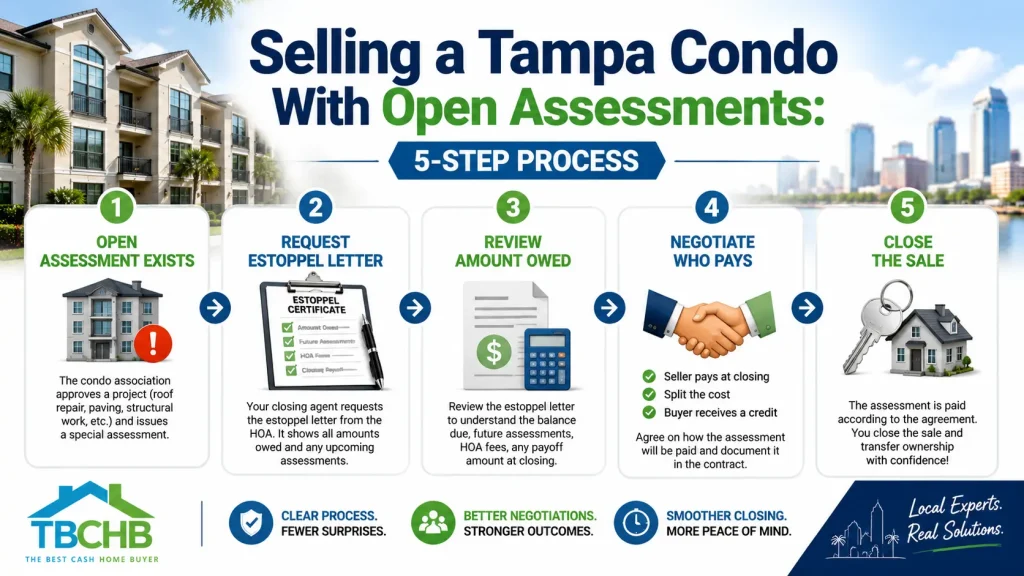
Here’s the part that matters for you as a seller: that balance has to be addressed at or before closing, either out of your proceeds or through a negotiated adjustment in the contract. And buyers will ask about it. They want to know two things: who’s paying it, and are more assessments coming after this one. Getting ahead of those questions is the difference between a smooth sale and a stalled one.
The estoppel letter is the document that tells everyone, you, the buyer, the title company, exactly what’s owed on the unit. Your closing team relies on it to know what has to be settled before the sale can close, so requesting it early matters more than people expect.
Under Florida Statute §718.116, the estoppel has to list everything owed at the time it’s issued, plus anything scheduled to come due while the certificate is still valid. It’s good for 30 days if delivered electronically or by hand, 35 days if mailed. If anything changes after that, a new one has to be issued.
One thing worth knowing upfront: HOA boards don’t always move fast, especially during certain times of year. If the estoppel takes a while to come through, your closing can slip while everyone waits on the association, which is one of the more common reasons a traditional Tampa condo sale loses momentum.
Open assessments touch two things directly: how much you walk away with, and how willing the buyer is to stay on schedule.
Buyers will often ask for a price concession or a closing credit to offset what’s left on the assessment, or they’ll want you to pay it off entirely before the sale transfers. Lenders sometimes look harder at large or upcoming assessments during underwriting too, which can add yet another delay if your paperwork isn’t ready when they ask for it.
The usual paths are: you pay it off, you give the buyer a credit, or you split it. Whichever you choose, get it in writing in the contract, not just talked through verbally. And here’s the honest truth: all of this, the back-and-forth over credits, the lender scrutiny, the waiting on HOA paperwork, is exactly the kind of friction that a cash buyer skips entirely. A cash sale doesn’t involve a lender pulling apart your assessment history, and there’s no buyer financing falling through over it.
Florida sellers generally have to disclose known facts that affect a property’s value and aren’t obvious to the buyer just from walking through it. Open assessments fall squarely into that category, and they need to show up both in your listing and in the estoppel certificate.
In practice, that means:
The goal is simple: don’t let a buyer find out about an open assessment late in the process. That’s when deals fall apart and trust erodes. When in doubt, share more than you think you need to, and loop in a Florida real estate attorney if your situation feels complicated. This isn’t legal advice.
Florida condo law lives in Chapter 718 of the Florida Statutes, and §718.116 is the section that governs estoppel certificates specifically: what they have to include, how long they’re valid, and what happens if an amendment is needed. The main thing to take away is that Tampa condo sales lean heavily on this one document, and the numbers on it need to be locked in before closing. You can read the full statute text directly if you want the details, but you don’t need to memorize it to sell your condo.
Get ahead of this before a buyer is even in the picture:
If reading that list feels like a lot, that’s a fair reaction, it is a lot. Some sellers decide they’d rather skip the whole process and sell as-is for cash instead, assessment and all.
There are really three questions buyers ask, every time:
Who pays this at closing? It’s negotiable and gets spelled out in the contract, usually as a closing credit, a seller-paid amount, or a split. The estoppel confirms the number; the contract decides who covers it.
Are more assessments coming? The estoppel shows anything already approved. For anything still under board discussion, sharing meeting minutes lets the buyer judge the risk for themselves.
Will this affect my loan? Possibly. Lenders can be cautious about large or upcoming assessments. Handing over the estoppel and supporting paperwork before the lender even asks is the best way to keep things moving.
These three questions are exactly where a traditional sale can slow to a crawl, rounds of back-and-forth, lender requests, buyer hesitation. A cash sale sidesteps most of it, since there’s no lender in the mix asking these questions in the first place.
A condo with a paid-off assessment reads differently to buyers than one with an open balance. Some buyers will pay a touch less just to have the assessment already handled, since it removes the uncertainty from their side entirely.
Buildings with older infrastructure or recent safety and reserve work tend to draw more buyer questions, which shapes how offers and contingencies get structured. Market strength, the type of building (downtown high-rise versus coastal), and how responsive the association is all affect how fast things move. The open-assessment uncertainty is exactly the kind of thing that can stretch out a traditional sale, and exactly the kind of thing a cash buyer is comfortable absorbing without all the extra back-and-forth.
When a buyer brings up the assessment, staying calm and direct keeps things moving. Something like:
“I want to be upfront with you, here’s the estoppel, here’s what’s owed, and here’s how I’m planning to handle it at closing. I’m open to [paying it off / a credit / splitting it], and we’ll put the exact numbers in the contract.”
If you’re talking to a cash buyer instead, the conversation gets even simpler: “I’m open to an as-is offer that factors in the assessment, no need to drag this through rounds of credits and lender back-and-forth.” Run anything you put in writing by your attorney or title company before it’s final, what you say and what the contract says need to match.
Who pays the special assessment at closing?
It’s negotiable, typically a closing credit, a seller-paid amount, or a split, and it gets written into the contract.
Are more assessments coming?
The estoppel shows anything already approved. For anything still under discussion, ask the HOA for meeting minutes so you can share that context with buyers.
Will an open assessment affect financing?
It can. Lenders sometimes scrutinize large or upcoming assessments. Having the estoppel ready before they ask helps avoid delays.
What is an estoppel letter and why does it matter?
It’s the condo association’s official statement of everything owed on your unit, current and scheduled. Buyers and title companies rely on it to know exactly what needs to be settled before closing.
Which Florida law covers condo assessments and disclosures?
Florida Statutes Chapter 718, specifically §718.116, governs estoppel certificates and what has to be disclosed in a condo sale.
Can I sell before a special assessment project is finished?
Yes. Buyers may ask about the project’s timeline and remaining costs, but sharing the estoppel and HOA documents early usually answers most of their concerns.
What if a new assessment gets approved after the estoppel is issued?
You’ll likely need an updated estoppel. Who’s responsible depends on the contract terms, when the assessment was approved, and your closing date.
Can I sell my Tampa condo for cash with open assessments?
Yes. The Best Cash Home Buyer purchases Tampa condos as-is, open assessments and all. There’s no need to negotiate credits, wait on a buyer’s lender, or get the HOA paperwork perfectly lined up before you can close.
Selling a Tampa condo with an open assessments is a common situation, not a dealbreaker. Once you understand how the estoppel works, how it shapes price and timing, and how to disclose clearly, most of the stress melts away. Staying organized, communicating openly with your agent and closing team, and leaning on official documents is what keeps buyers confident and your proceeds protected.
But if the back-and-forth, credits, lender questions, HOA delays, just isn’t worth it to you, there’s a simpler path. The Best Cash Home Buyer buys Florida condos as-is, open assessments included, with no repairs, no showings, no commissions, and no buyer financing drama to navigate. Take a look at how the process works, browse our FAQ, or reach out today for a no-obligation cash offer on your Tampa or wider Tampa Bay condo.
