
You’re sitting in your single-wide in a Florida park, staring at a lot rent increase notice. A repair quote for a soft floor sits right beside it. You wonder if anyone will buy with storm patches on the roof and strict park rules.
The good news is that selling a mobile home in Florida is very doable. The best route depends on whether you own the land, how fast you need to move, and your paperwork. Most sellers choose between a dealer or agent, the park, a private sale, or a cash buyer.
This guide covers what to do first, which documents you need, and what costs to expect. It also shows how to sell quickly without leaving money on the table. You’ll see how park rules and Florida taxes affect your final check.
Before you list, answer one question first. Are you selling the home and land together, or just the home on a rented lot? That single detail changes your paperwork, your buyer pool, and how you close.
If you pay lot rent in a park, the home is usually treated as personal property, much like a vehicle. Title and registration run through Florida Highway Safety and Motor Vehicles rather than a recorded deed. Park tenancies also fall under the Florida Mobile Home Act (Chapter 723), which shapes leases and park rules. Buyers must also qualify with the park before ownership passes.
| Factor | Home on rented lot (personal property) | Home on owned land (real property) |
| What you sell | The structure only | The land and home together |
| How ownership transfers | Signed title and FLHSMV transfer paperwork | Deed recorded with the county |
| Who handles closing | Seller, buyer, and FLHSMV, often with a title company | A Florida title company or real estate attorney |
| Buyer hurdles | Park approval, age rules, credit and background checks | Lender, appraisal, insurance, and foundation rules |
| Common examples | Single-wides in 55+ parks, inherited park units | Double-wides on private lots in small towns |
A quick way to tell is to check your mail. Lot rent statements and park applications point to personal property. A yearly property tax bill listing land and improvements points to real property.
Why this distinction matters when you sell:
• Paperwork: A title and bill of sale for park homes, or a full closing package for land sales.
• Buyers: Park-approved buyers, financed buyers, or cash buyers who skip lenders entirely.
• Financing: Lenders are often picky about older homes, park-based homes, and condition issues.
• Condition: Unpermitted porches or storm-patched roofs can stall lenders and parks, but rarely stop a cash sale.
Florida mobile homes often come with quirks like older additions that were never inspected. These issues don’t always kill a sale, but they affect who will buy. A cash buyer usually starts by figuring out which ownership bucket you’re in.
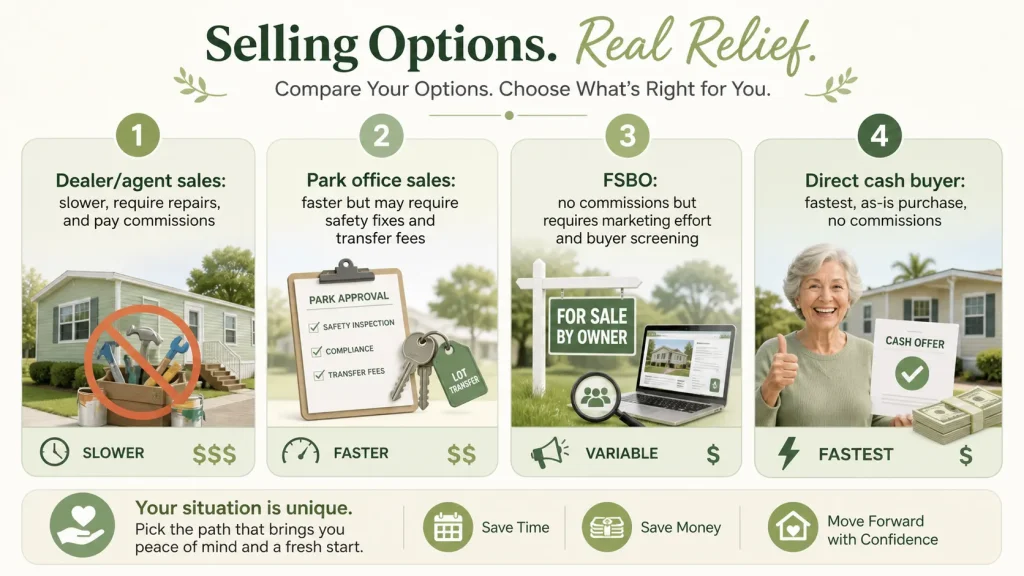
You have four main paths when you sell a mobile home in Florida. Each one trades off time, hassle, and your final net proceeds. Your choice should match your timeline, the home’s condition, and how much hassle you can handle. The table below compares them side by side.
| Option | Typical timeline | Repairs needed | Fees | Closing certainty |
| Dealer or real estate agent | Often slower; depends on price and demand | Solid cosmetics and basic repairs | Commission from proceeds | Lower; financing and park approval can derail it |
| Park sales office | Faster in popular parks | Park may require safety fixes | Possible transfer fees | Fairly solid if the buyer qualifies |
| For sale by owner (FSBO) | Varies with pricing and marketing | Your call, but retail buyers expect more | No commission; you pay for marketing | Depends on how well you screen buyers |
| Direct cash buyer | Often the fastest route | Usually as-is | Usually no commissions | Higher; no lender involved |
Timelines are general patterns, not guarantees. Park rules, condition, and paperwork can speed a deal up or slow it down.
Real situations make the choice clearer. A newer double-wide in a popular 55+ park may do well with a dealer. An older single-wide with soft floors and back rent usually draws more cash-buyer interest. A vacant inherited unit often fits a cash sale when heirs live out of state.
Which path fits your situation?
• Dealer or agent: Best for newer homes in desirable parks when you can afford to wait.
• Park office: Works well if your park has a waiting list and actively helps owners sell.
• FSBO: Suits sellers comfortable handling calls, showings, and paperwork to skip commissions.
• Cash buyer: Fits older homes, storm damage, inherited units, back lot rent, or tight deadlines.
If your home already sat unsold, learn what to do when your house has been listed for months and won’t sell. Remember that the highest advertised price does not always leave the most in your pocket.
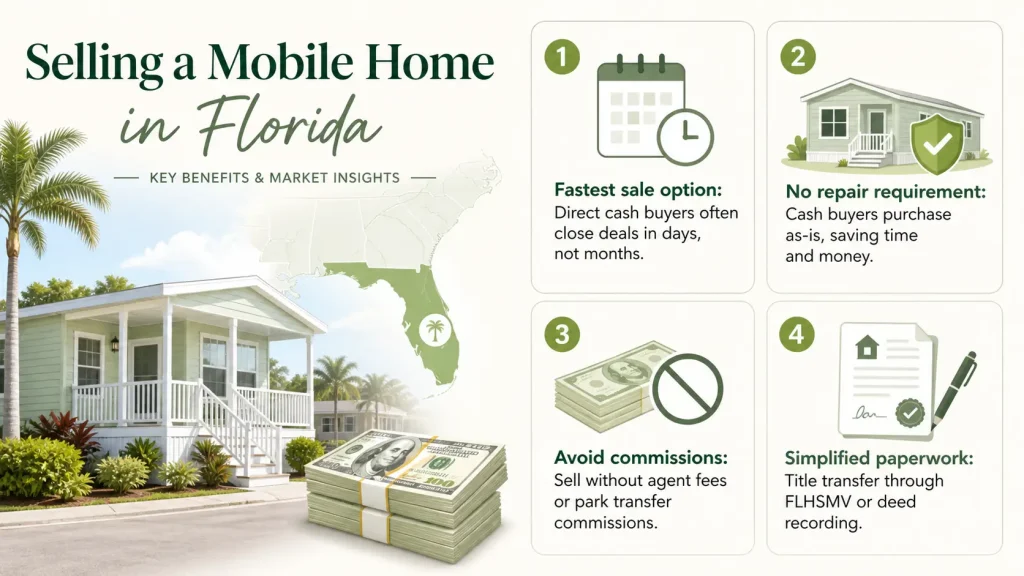
Selling breaks down into a manageable checklist. Take the steps one at a time, whether your home is spotless or patched together.
1. Confirm what you own. Check lot rent statements, tax bills, and your title or deed to identify personal or real property.
2. Gather your documents. Pull your title, VIN or serial number, registration, lien papers, park lease, and any back-rent letters.
3. Talk to the park office. Ask about buyer age limits, credit checks, right of first refusal, application fees, and back-rent rules.
4. Choose your sale path. Match the option to your timeline, the home’s condition, and your stress level.
5. Do right-sized prep. Fix active leaks and dangerous soft spots, clear clutter, and handle park-required safety items.
6. Market the home or request offers. Post clear photos and an honest description, or send details to a cash buyer.
7. Negotiate price and terms. Weigh park approval odds, lien payoffs, and repair requests alongside the price.
8. Sign and transfer ownership. Endorse the title and complete FLHSMV transfer steps, or sign a deed at a title company.
You don’t need to turn an older single-wide into a model home. Focus on safety basics and a solid cleanout so buyers can see what they’re buying. With a direct cash buyer, repair work is usually reflected in the offer instead.
Park questions deserve extra attention because they stall many deals. The process feels similar to selling a house with HOA violations in Florida, where community rules decide who can buy. The state’s Division of Florida Condominiums, Timeshares, and Mobile Homes oversees parks and handles resident complaints.
With a cash buyer, the process is shorter and simpler. Here is what it usually looks like:
• A short phone call to cover your home, park, and timeline.
• A walkthrough in person or through photos and video.
• A written cash offer showing a clear net number.
• Title checks, park approvals, and payoffs handled with a title company.
• A closing date you choose to match your move.
Missing paperwork feels scary, but most gaps are fixable. Knowing what you need helps you and your closing agent plug holes early. Here is what you usually need, split by ownership setup.
| Document | Rented lot (personal property) | Owned land (real property) |
| Ownership proof | Florida mobile home title in your name | Warranty, special warranty, or quitclaim deed |
| Loan documents | Lien release if you ever had a loan | Mortgage payoff statement |
| Sale record | Bill of sale | Purchase agreement and closing statement |
| State or county filing | FLHSMV notice-of-sale or transfer paperwork | Deed recorded with the county |
| Other items | Park application, rules acknowledgment, rent ledger | Title insurance and property tax information |
These filings record the transfer and protect you if the buyer doesn’t retitle promptly. Form names and requirements change over time. Confirm current steps with FLHSMV or a title professional before closing.
Lost or messy paperwork? Here are common fixes:
• Lost title: Florida offers a duplicate or replacement title process through FLHSMV.
• Misspelled name or wrong VIN: A corrected title can fix mismatches, though it takes time and fees.
• Ex or deceased relative listed: Everyone on the title, or their legal representative, usually must sign.
• Old lien showing: Get a written lien release from the lender before closing.
A good buyer will tell you exactly which documents apply to your situation. Don’t let paperwork fear keep you stuck. List what you have and what’s missing, then ask the park, FLHSMV, or a title professional for help.
The sale price is not the check you take home. What matters is your net proceeds after every cost is paid. Costs fall into carrying costs, sale costs, payoffs, and transfer taxes.
| Cost type | Examples | When it hits |
| Carrying costs | Lot rent, utilities, insurance, registration fees, land property taxes | Monthly or yearly until closing |
| Sale costs | Commissions, repairs, cleanup, closing and document fees | At or before closing |
| Payoffs | Loans, liens, back lot rent, unpaid taxes | At closing, from proceeds |
| Transfer taxes | Documentary stamp tax on a deed when land is included | At closing |
The Florida Department of Revenue documentary stamp tax guidance explains that this tax applies to deeds transferring Florida real property. Your title company or attorney calculates any amount due at closing. Carrying costs also add up fast on an empty unit, just like the costs of holding a vacant house.
Income taxes depend on whether the home was your primary residence, how long you owned it, and your gain. IRS Publication 523 covers the home sale exclusion and gain calculations. A tax professional can confirm what applies to you.
Compare offers on net proceeds, not the headline price:
• Retail sale: A higher contract price, minus commissions, repairs, carrying costs, and closing fees.
• As-is cash sale: A lower sticker price, but often no commissions, no major repairs, and fewer months of lot rent.
In that comparison, the lower offer can sometimes leave more in your pocket. It also delivers a faster, cleaner exit. List every line item on your side before comparing any two offers.
Most roadblocks slow a sale down but rarely end it. Knowing them early helps you plan around them.
• Back lot rent or park fines: Parks often require balances cleared before approving a buyer, sometimes at closing.
• Park rules blocking buyers: Age limits, credit checks, and pet rules shrink your buyer pool.
• Unpaid property taxes: If land is included, the title company pays these from sale proceeds.
• Storm damage and roof leaks: Parks and lenders may balk, but cash buyers often buy as-is. See how selling a house with a leaking roof in Florida works.
• Insurance gaps after storms: Understanding your hurricane deductible in Florida helps you decide whether to repair or sell.
• Land or park deals: Selling multiple pads or a whole park usually needs a park-specialist attorney or broker.
If a problem feels like a dead end, talk openly with the park, a title company, or an experienced buyer. The sooner you share the issue, the sooner someone can map a realistic path forward.
To sell a mobile home fast in Florida, pull the levers you control. Speed comes from preparation, honest pricing, and flexible scheduling.
• Gather your title, VIN, park lease, and lien documents before listing.
• Bring small balances current so the park can approve buyers quickly.
• Price based on age, park, and condition, not on newer double-wides.
• Stay flexible on showings and closing dates.
A cash buyer doesn’t need lender approval, so no bank dictates repairs or rejects an older home. The Best Cash Home Buyer is a direct cash home buyer that does not list properties on the MLS. Age, condition, and park quirks are priced into one written offer upfront.
A cash sale won’t magically fix every title problem. It does turn many moving parts into one clear offer and a firm next step. Watch for red flags like buyers who refuse written offers or keep changing the price after agreeing.
What to expect from a reputable Florida cash buyer:
• A clear, written offer spelling out the price and who pays which costs.
• Closing through a reputable Florida title company.
• Help coordinating with the park office on approvals and back rent.
• A real closing plan instead of endless promises.
You need a title in your name, any lien releases, a bill of sale, and FLHSMV transfer paperwork. Park approval forms apply on rented lots. Homes sold with land use a deed and closing package.
Traditional listings often take longer because of repairs, showings, financing, and park approvals. Missing titles and overpricing cause the most delays. A direct cash sale is usually faster because no lender is involved.
Yes. Many investors and cash buyers purchase mobile homes as-is, including older units with storm damage. The price reflects the condition, so you can skip major repairs and deep cleaning.
Possibly. Income tax depends on residence status, ownership length, and gain. Documentary stamp tax may apply when land transfers by deed. A tax professional or title company can confirm your situation.
Yes. Age limits, credit checks, income requirements, and back-rent policies narrow your buyer pool. A buyer can love your home and still be denied, so learn the rules first.
Yes. A cash buyer doesn’t rely on lender approval, so older homes, strict parks, and condition issues remain workable. Closing should still use proper paperwork and a Florida title company.
Selling a mobile home in Florida comes down to a few core pieces. Know what you own, pick the right sale path, line up paperwork, and compare offers on net proceeds. Be honest about costs and hiccups, and the rest gets easier.
Maybe you’re staring at soft floors, a stack of lot rent notices, or an inherited unit you never asked for. Each of those situations has a clear path forward once you know your options.
If you want a simple way out, The Best Cash Home Buyer buys mobile homes across Florida from its base in St. Petersburg. Call (727) 291-9712 to talk through an as-is cash offer. There are no commissions, no major repairs, and a closing date that fits your move.
