
You are standing in your Florida kitchen, solar lease statement in one hand and a listing plan in the other. Your agent or title company just said the lease must be handled before closing. That news can feel like a roadblock. It usually is not.
Selling a house with a solar panel lease in Florida is absolutely possible. The key is choosing early between a solar lease transfer, a buyout, or another exit. Then you loop in your solar company and Florida title company from day one. Most delays happen when sellers treat the lease as an afterthought.
I’m John Gardepe, a St. Petersburg cash home buyer who helps Florida homeowners sell in tough situations. I’ve seen leased solar be a small extra step, and I’ve seen it stall a sale late. This guide shows you how to keep it in the first group.
A solar panel lease means you rent the equipment from a solar company. You make a monthly payment, and the company keeps ownership of the panels. You get the power the system produces, but you never own the equipment unless the contract allows a purchase. Think of it like renting a water heater, only on your roof and for much longer.
That differs from panels bought with cash or a loan. Owned panels act like any other home improvement. Leased panels stay tied to a contract that controls what happens when you sell.
| Ownership Type | Who Owns the Panels | What Usually Happens at Sale |
| Solar lease or PPA | The solar company | Buyer assumes it, seller buys it out, or the company removes it |
| Loan-financed system | Homeowner, with a loan attached | The loan is typically paid off or handled at closing |
| Owned outright | Homeowner | Panels generally convey with the house like other improvements |
Most leases run for many years, and some include scheduled payment increases. The U.S. Treasury’s consumer solar guidance notes that leasing companies usually handle maintenance. It also explains that tax credits generally go to the system’s owner, not the homeowner.
Here is where leased solar panels can complicate a Florida sale:
• Buyer pushback. Some buyers reject another monthly bill on top of their mortgage, insurance, and HOA dues.
• Appraisal questions. Appraisers may treat leased equipment differently from owned, permanent improvements.
• Roof and insurance concerns. Buyers ask about the roof under the panels and who covers storm damage. If your roof already has problems, review our guide on selling a house with a leaking roof in Florida.
• Lender scrutiny. A buyer’s lender may count the lease payment and ask whether the contract is assumable.
Your first step is simple. Pull your full lease, all amendments, and recent bills. Then put them in front of a Florida real estate attorney or title company early.
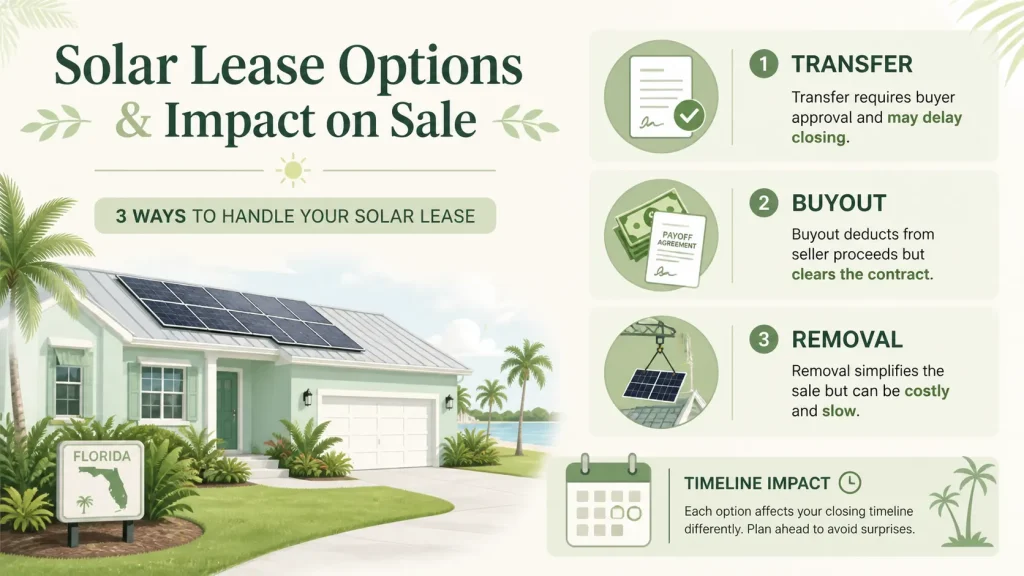
Most sellers face four paths when handling leased solar panels at sale. The right one depends on your contract, your timeline, and your buyer. Always compare them using net proceeds, not just the contract price. Each path affects your timeline, buyer pool, and bottom line differently.
| Option | How It Works | Pros | Cons |
| Solar lease transfer | Buyer applies and takes over the payments for the remaining term | No large upfront cost; panels stay on the home | Buyer may refuse or fail approval; transfers can delay closing |
| Solar lease buyout | You pay the payoff amount, often from sale proceeds at closing | Buyer inherits no contract; cleaner lender file | Can be a large deduction from your proceeds |
| Relocate the system | Company moves the panels to your next home, if allowed | You keep your system and existing savings | Costly, slow, and not permitted in every contract |
| Termination or removal | Company ends the lease and removes the equipment | Simplifies the buyer’s financing and inspection | Fees can be high; removal adds a scheduling step |
A buyout usually appears as a payoff line on your Florida closing statement. The title company deducts the solar lease payoff and sends it directly to the solar company. You then receive the remaining net proceeds after other costs.
Before choosing a path, get these numbers in writing from your solar provider:
• Current monthly payment and the remaining lease term
• Exact payoff quote and how long that quote stays valid
• Transfer fees and the buyer approval requirements, including credit checks
• Removal or relocation costs, if your contract allows either option
• Any roof repair responsibility the solar company accepts during removal
The highest offer on paper is not always the best deal. Payoffs, buyer credits, extra holding months, and late cancellations all shrink what you keep. A cash buyer can sometimes build the payoff or transfer into the offer from the start.
A solar lease can help or hurt, depending on the numbers and the buyer. Some Florida buyers love lower power bills and maintenance handled by the solar company. Others see a long contract they never chose and simply walk away.
Buyers mostly care about simple math. They compare the lease payment against expected savings on hot-summer electric bills. If savings clearly beat the payment, the system feels like a benefit instead of a burden.
The numbers buyers weigh most include:
• Monthly lease payment and any scheduled escalator increases over time
• Average electric bill savings shown on recent FPL, Duke, or TECO statements
• Years left on the lease term and any end-of-term purchase option
• Whether maintenance, monitoring, or production guarantees are included in the contract
You can tilt the odds in your favor with a little preparation. Give buyers clear facts instead of letting them imagine the worst. Clarity builds trust quickly.
• Prepare a one-page summary. Show the payment, average usage, savings, and remaining term on a single sheet.
• Use honest listing language. Describe the home as having leased solar, with full lease details available for review.
• Back up savings claims. Mention lower bills only if your actual statements support that claim.
• Keep documents ready. Have the lease, amendments, and bills available for showings, inspections, and serious buyers.
If the lease keeps scaring buyers or creating financing friction, don’t panic. A cash buyer who evaluates the entire deal can often keep your sale moving.
Plan to disclose the solar lease clearly and early. You are disclosing a contract, a payment obligation, and possibly a recorded interest. Share any disputes, missed payments, or unusual terms with your title team.
HOA concerns rarely block solar in Florida. Florida Statute 163.04 bars deed restrictions and associations from prohibiting solar collectors. Associations can still have a say on roof placement within limits. If you have other open association issues, read our guide on selling a house with HOA violations in Florida.
Title companies also look for a UCC filing solar providers may record against the equipment. A UCC filing is public notice that a company claims an interest in certain goods. Under Florida’s UCC filing-office statute, fixture filings go to the county clerk of court.
If a UCC-1 from your solar provider shows up, title may require one of these:
• A payoff at closing followed by a release of the filing
• A formal assignment of the lease to your buyer
• Written consent from the solar company for the transfer
• Any other document your title team needs to clear the record
Here is how each key player usually views leased solar in a Florida sale:
| Party | What They Review | What They May Need |
| Mortgage lender | Lease payment in the debt-to-income review; whether it’s assumable | Lease copy, transfer terms, and solar company approval |
| Appraiser | Whether the panels are owned or third-party equipment | Proof of ownership status and lease terms |
| Title company | UCC-1 or other recorded interest from the solar provider | Payoff, assignment, release, or consent documents |
| Solar company | Buyer qualification and transfer paperwork | Application, signed assignment, or payoff funds |
Fannie Mae’s Selling Guide rules for solar panels set specific requirements for leased systems on conventional loans. Its guidance on appraising properties with solar panels explains how ownership affects value. In short, don’t count on leased panels raising your appraisal. More moving parts also give a cautious underwriter more reasons to pause the file.
Point To Note: I’m not your attorney or title company. Exact contract wording and legal advice should come from a Florida real estate attorney or your title team.
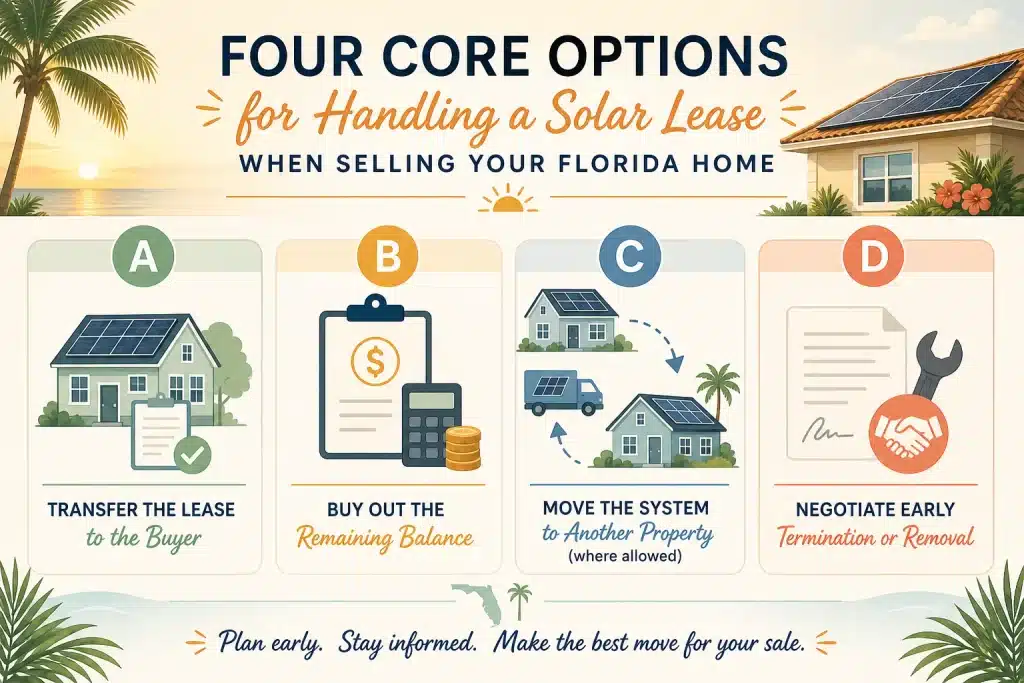
When your move-out date is circled on the calendar, you need a plan, not theory. Here’s a step-by-step process I walk Florida sellers through when they have a solar lease:
1. Gather your paperwork. Pull the full solar lease agreement, any amendments, recent electric bills showing the solar payment and power usage, and any emails or letters from the solar company.
2. Collect key contact info. Write down the solar company’s customer service number, your account number, and any specific contact you have dealt with. Share this with anyone helping you sell, including your agent, attorney, title company, or buyer.
3. Call the solar provider about your options. Ask what happens if you sell your Florida home. Find out whether they allow transfers, whether they require buyer approval, and whether there is a buyout option.
4. Get everything in writing. Request a written payoff quote, current payment amount, remaining term, any transfer fees, and an outline of their transfer steps and timelines. This becomes your reference sheet.
5. Decide how you want to sell. If your timeline is flexible, the house is in good shape, and you are not behind on payments, you might choose to list with an agent and look for a buyer willing to assume the lease. If the property is inherited, vacant, facing foreclosure, or has an older roof under the panels, you may decide to talk directly to a Florida cash buyer instead.
6. Loop in your title company or attorney early. Share the lease, payoff quote, and any UCC information with the Florida title company handling your closing or with your real estate attorney. Ask them what they need from the solar company and how they want everything documented.
7. Work the lease into your pricing and negotiation. Decide upfront whether you are willing to pay off the lease, split costs with the buyer, offer credits, or discount the price in exchange for a quick as-is sale. Run the numbers based on net proceeds, not just the contract price.
8. Watch the approval timeline. Solar companies may need time to review a buyer for a transfer and coordinate paperwork. Do not start the process a few days before closing and expect everything to line up cleanly.
9. Plan a fallback. If a buyer’s financing falls apart over the lease, or the solar company will not approve the transfer, decide in advance whether you will switch to a buyout, negotiate removal, or pivot to a cash buyer who can step in quickly.
Solar companies need time to review buyers and process paperwork. Don’t start the solar lease transfer a few days before closing and expect a clean finish.
Behind on payments or racing a deadline? Use a fast-track version instead. Call a reputable Florida cash buyer first and share your lease and payoff details. Let their team and title company handle most of the solar coordination.
If the house is empty while you work through this, carrying costs add up fast. Our guide on selling a vacant house in Tampa breaks down those costs and your options.
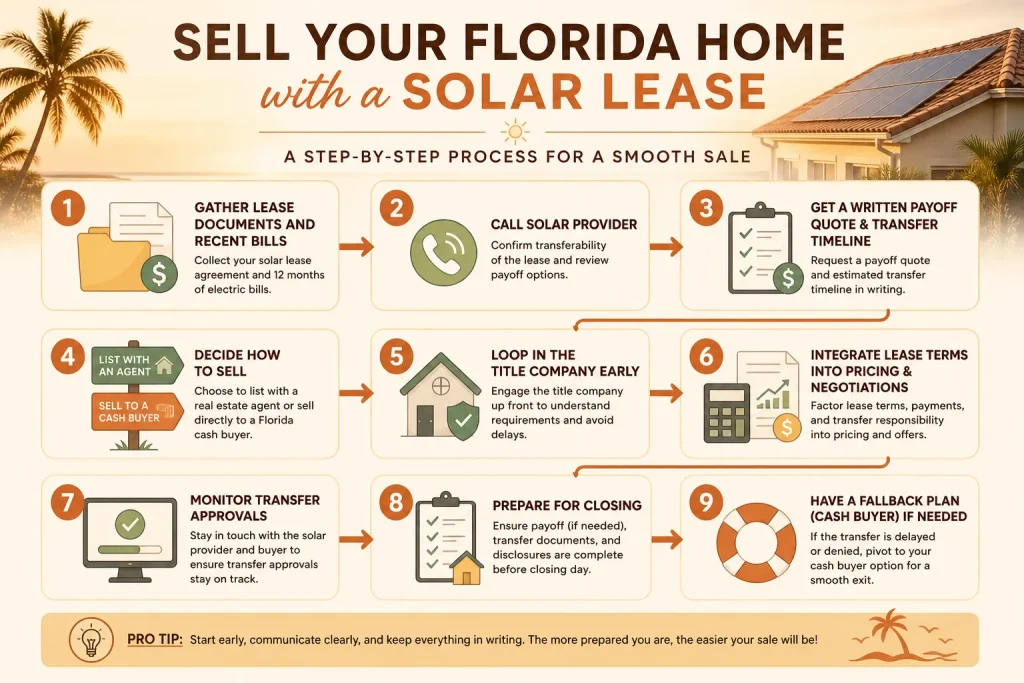
If a financed deal already collapsed over the lease, you may be weighing your next move. Here’s how the two paths usually compare when leased solar is involved.
| Factor | List With an Agent | Sell to a Local Cash Buyer |
| Timeline | Prep, showings, inspections, lender approval, and solar approval can stretch closing | One cleaner window once title and solar paperwork are ready |
| Showings | Multiple showings; each buyer needs the lease explained again | Usually one walkthrough; the lease is reviewed once |
| Financing risk | Underwriters may pause or reject the file over the lease | No lender, so no underwriter second-guessing the lease |
| Solar coordination | You and your agent juggle calls with the solar provider | The buyer’s team helps coordinate with solar and title |
| Repairs | Buyers often request roof repairs and cosmetic updates | Purchased as-is; condition is factored into the offer |
| Net proceeds | Higher list price, minus commissions, credits, and holding costs | Lower price, but no commissions and fewer holding costs |
Listing can make sense with strong equity, a newer roof, and flexible timing. A cash sale often fits better when pressure is high and patience is low.
Situations where selling to a cash home buyer in Florida often wins:
• You’re behind on lease or mortgage payments and facing deadlines.
• A lender already killed a deal over the solar lease.
• Storm damage hit the roof or panels. Learn how to sell a house with an open insurance claim in Florida.
• You’re unsure repairs are worth it after reviewing your hurricane deductible in Florida.
• The home is inherited, vacant, or simply more than you want to manage.
• You want one firm closing date you can actually plan a move around.
A cash offer doesn’t erase the solar lease. It gives you one buyer, one timeline, and one net number to decide around.
With no lender involved, the file has fewer moving parts. Title work and solar steps still happen, just without an underwriter adding last-minute conditions.
Yes. Decide early whether you’ll transfer the lease, buy it out, or pursue removal. Involve your solar company and Florida title company from the start so the lease doesn’t become a late surprise.
Usually, if your contract allows it. Most solar companies require the buyer to apply and be approved. Start the transfer early and give your title company all lease paperwork well before closing.
Generally, you shouldn’t count on it. Because the solar company owns leased panels, appraisers often treat them separately from the home. Owned systems are more likely to add appraised value.
Not necessarily. You can often pay it off at closing from sale proceeds or have the buyer assume it. The right choice depends on your contract and your net proceeds.
Gather the full lease, amendments, a current payoff statement, and recent electric bills. Add any transfer forms and your provider’s contact details. Share everything with your Florida title company early.
Often, yes. A cash buyer isn’t bound by mortgage underwriting. If the solar provider and title company handle the paperwork correctly, closing can proceed even after a financed deal fails.
Selling a house with a solar panel lease in Florida doesn’t have to mean months of showings and lender drama. The Best Cash Home Buyer buys as-is across Tampa Bay and greater Florida from our St. Petersburg office. Get a fair cash offer in 24 hours, with no repairs and no commissions.
You pick the closing date. Our team works with your title company to handle the details with your solar provider. Get your numbers on paper, then decide if a clean cash sale fits your goals.
