

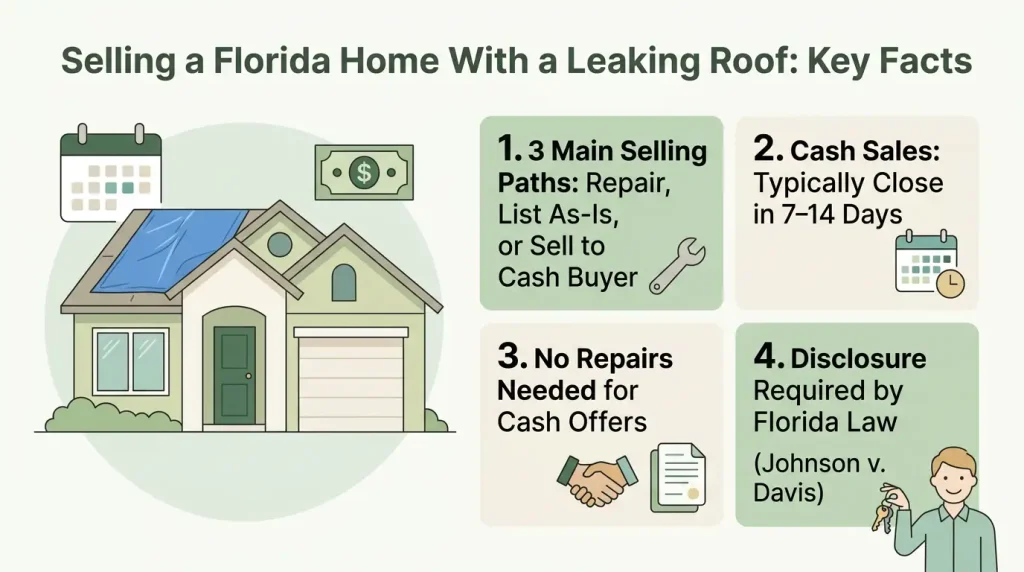
A leaking roof can make your home feel unsellable. In reality, selling a house with a leaking roof in Florida is possible if you disclose the problem honestly and pick the right buyer. Your three main paths are repairing the roof, listing as-is, or selling directly to a Florida cash home buyer who prices the leak into the offer.
This guide covers Florida disclosure rules, how roof age affects insurance and financing, and the real math behind repairing versus selling as-is. We also cover what to do the moment you notice water coming in, since panic rarely helps.
We see tarped roofs, active leaks, and storm damage often across Florida. The goal here is straight answers, not scare tactics, so you can choose a path with confidence.
Whether your leak started last night or has been an open secret for months, the path forward is the same: get honest about the condition, then match that condition to the right kind of buyer.
Yes, you can legally sell a house with a leaking roof in Florida. You simply need to disclose what you know and match your sale strategy to the type of buyer you target. Skipping disclosure is the only real way to get into legal trouble here.
Roof problems generally fall into three categories, and each one changes how buyers respond:
Buyers react very differently depending on how they are financing the purchase:
A leaking roof narrows your buyer pool but does not eliminate it. Being upfront about the leak from the first conversation is what keeps your options open and your timeline predictable.
You have probably seen homes with blue tarps still on the roof after a storm. To many financed buyers, a tarp signals bigger issues underneath, so they lean heavily on inspections and lender conditions before agreeing to anything.
Florida law expects you to disclose known roof leaks and related damage, even in an as-is sale. This duty comes from the Florida Supreme Court case Johnson v. Davis, which requires sellers to reveal known latent material defects. The as-is label does not remove this obligation, no matter how the contract is worded.
A material defect is anything that would matter to a reasonable buyer’s decision, such as value, safety, or usability. A latent defect is a hidden problem, like a leak behind a wall, that is not obvious on a casual walkthrough. Most traditional Florida sales use the Florida Realtors Seller’s Property Disclosure form, which directly asks about roof soundness, leaks, and repairs.
Hiding a leak risks a future lawsuit, forced repair costs, or a deal that collapses once an inspector or roofer finds the problem anyway. Written disclosure protects both sides because everyone knows exactly what was said and agreed to.
If your leak connects to broader water issues, this guide on Florida flood and water disclosure duties is worth reading. Many sellers feel real relief once they stop trying to hide a leak and simply write down the truth one time.
Disclosure does not mean you must fix every issue before you sell. It simply means buyers, especially cash buyers, get the facts they need to make a fair, informed offer on your home.
A verbal mention during a showing is not the same as a written disclosure. Put the leak, its history, and any repairs in writing so there is a clear record if questions come up later.
Florida has no single official 15-year roof law, despite what many sellers hear from friends or agents. Instead, insurers set their own age guidelines, and those internal rules can make financing harder for your eventual buyer. Some carriers decline new policies on older roofs entirely, while others allow actual cash value coverage instead of full replacement cost.
FHFA confirms Fannie Mae does not require roof replacement as a blanket rule and permits actual cash value insurance on one-to-four unit properties. Fannie Mae’s guide still requires homes to be in acceptable physical condition and to meet minimum insurance coverage requirements before a loan can close.
| Roof Type | How Buyers View It | Why It Matters in a Sale |
| Asphalt shingle | Common, but closely watched as it ages | Buyers and insurers expect roof work sooner |
| Concrete or clay tile | Seen as durable, though repairs are more involved | Cracked tiles and water intrusion still raise concern |
| Metal | Viewed as durable when properly installed | Flashing, fasteners, and storm damage still matter |
| Flat or low-slope | Gets extra scrutiny for drainage and ponding | Leaks are harder for buyers to evaluate alone |
An active leak layered on top of roof age often leads insurers to limit coverage and lenders to condition the loan on repairs or replacement. Appraisers may also flag a short remaining roof life, which adds another hurdle for a financed buyer.
What matters most to you as the seller is net proceeds, not the sticker price on a contract. A buyer chasing a new roof may offer a higher number, but repair costs and delays can quietly erase that gap. A broader as-is selling guide can help you compare the repair path against the as-is path in more detail.
Higher premiums or coverage limits on an older roof also raise a buyer’s monthly costs, which lenders factor into loan approval. That ripple effect is often invisible to sellers until an underwriter flags it late in the process.
A cash buyer sidesteps this entirely, since there is no lender reviewing insurance quotes before closing. That is one reason cash offers on older, leak-prone homes can move faster than financed ones.
You generally have three paths available: repair the roof and list traditionally, list as-is and negotiate credits with buyers, or sell as-is directly to a cash buyer who prices the roof into the offer upfront. Each path trades upfront cost against speed, certainty, and stress.
| Factor | Repair Then List | List As-Is | Sell to a Cash Buyer |
| Upfront cost | Highest, paid before listing | Lower, minor fixes only | Lowest, no repairs needed |
| Time to closing | Longest, permits and bids add delay | Medium to long | Usually shortest |
| Risk of buyer backing out | Moderate | Higher, due to inspections | Lower |
| Stress level | High, contractors and showings | High, repeated inspections | Lower, one buyer and one walkthrough |
A repaired home may fetch a higher sticker price on paper, but roof work, interior repairs, commissions, and carrying costs can erase most of that gap. Extra weeks on the market also mean more mortgage payments, insurance, and utility bills coming out of your pocket.
The offer that leaves you the most net cash for the least stress is often the smarter choice, not necessarily the highest number on the contract. Sometimes repair-and-list genuinely wins; other times, especially with older roofs or storm damage, the as-is cash path is the clearer route.
Picture two offers on the same home: one higher offer contingent on a full roof replacement, and one lower as-is cash offer with no conditions. Once repair costs, commissions, and weeks of carrying costs are subtracted, the two numbers often land much closer together than they first appear.
Repairs also have a habit of uncovering more problems once contractors open up a ceiling or a section of roof deck. What looked like a simple patch job can quickly grow into a larger, more expensive project than the original estimate suggested.
A leaking roof can trigger a chain reaction for financed buyers that has nothing to do with your asking price. Inspectors flag missing shingles, soft spots, or visible leaks, and those notes often become formal loan conditions. Older homes may also require a 4-point inspection covering the roof, electrical, plumbing, and HVAC systems.
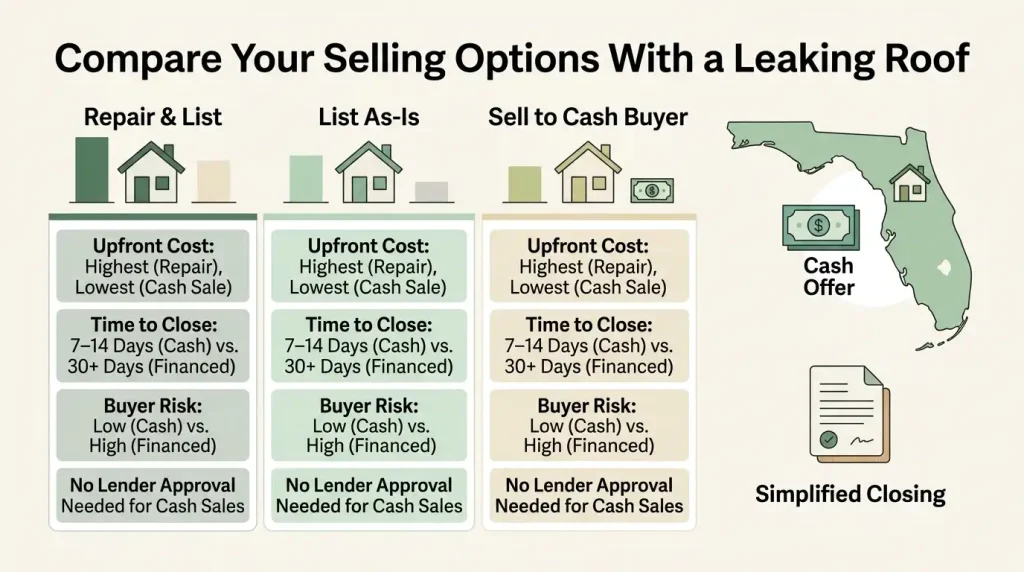
Cash buyers skip nearly all of these checkpoints. They still care about the roof, but they express that concern through pricing rather than repair demands or last-minute conditions. There is no underwriter deciding whether your house qualifies.
Learn more about how as-is sales work when a cash buyer inspects your home if you want to see the difference firsthand before you commit to either path.
The riskiest moment in any financed sale is often late in the process, after inspections and appraisal are done. A roof issue surfacing at that stage can send both sides back to the negotiating table under real time pressure.
If water is actively entering your home, start with safety and documentation before deciding how to sell. These first steps protect both your home and your negotiating position later.
When talking with buyers or agents, be direct: state plainly that the roof needs work, share any estimates or insurance information you have, and price the home to reflect its real condition. Honesty here almost always saves time later.
If your leak followed a storm, this guide on selling a storm-damaged house in Florida as-is may help you plan next steps. If mold has developed from a long-running leak, see selling a Florida house with mold damage for a closer look at that specific situation.
It also helps to gather any past roof paperwork you still have, including old invoices, permits, or prior insurance claims. That history helps buyers understand whether this is a first-time issue or part of a longer pattern.
Selling as-is to a Florida cash home buyer removes the roof problem from your plate entirely. You are not asked to repair anything, clean out every room, or hold your breath through a lender’s approval process.
The process is straightforward from start to finish:
A few practical facts also matter when you are deciding who to trust with a leaking-roof sale:
| Quick Facts | Detail |
| Company | The Best Cash Home Buyer |
| Founded | 2022 |
| Accreditation | BBB A+ accredited since October 13, 2023 |
| Service area | Florida, with deep roots in Tampa Bay and the Gulf Coast |
A dropped or non-renewed insurance policy does not block a cash closing, since there is no mortgage-mandated policy required at closing. Mold or storm damage does not automatically end the conversation either; it simply factors into the offer.
Sellers who choose this route are often dealing with more than just the roof: a tight relocation deadline, an inherited property, or simply a home they no longer have the energy or budget to repair. A cash sale lets you exit on your own timeline instead of a lender’s.
This guide focuses on current owners. If you are a buyer who suspects a past seller hid a leak, a Florida real estate attorney is the right resource, since Johnson v. Davis disputes are highly fact-specific. To understand cash buyers more broadly before you talk with anyone, see how Florida cash home buyers work.
If you are ready to compare your options, there are no roof repairs, no lender approval, no repair negotiations, no commissions, and no closing costs required when you sell directly to us. Reach our team at (727) 291-9712 or Offers@thebestcashhomebuyer.com to see what a no-obligation cash offer looks like.
Whichever path you choose, the same rule applies across every option in this guide: disclose the leak honestly, understand how it affects insurance and financing, and price the home to match its real condition. That combination keeps a leaking roof from becoming a bigger problem than it needs to be.
Yes, as long as you disclose known leaks and related damage. Johnson v. Davis requires disclosure of latent defects, and the as-is label does not remove that duty from you as the seller.
No. You can repair first, list as-is and negotiate with buyers, or sell to a cash buyer who prices the roof into the offer. Each path trades upfront cost against speed and buyer pool size.
Disclose active leaks, past leak history, completed repairs, and known damage like mold or rotten wood. The Florida Realtors disclosure form asks about all of these directly, so use it as your checklist.
Lenders following Fannie Mae guidance expect insurable, acceptable-condition homes before funding a loan. A leaking roof can trigger repair conditions, insurance denials, or delayed closing for financed buyers, though cash buyers are unaffected by these checkpoints entirely.
Cash sales typically close faster than repairing the roof and waiting on a financed buyer. Timing depends mainly on title work and your preferred closing date, not on lender approval or insurance conditions.
Not usually. An experienced Florida cash buyer expects leaks and sometimes mold in older Florida homes, and factors the repair scope into the offer rather than declining the house outright entirely.
Yes. Since a cash sale does not require a mortgage-mandated policy at closing, a dropped or non-renewed policy does not block the sale from moving forward on schedule.
