

You’re staring at another flood insurance renewal or a repair bill after a Tampa storm, wondering if you should sell before hurricane season hits again. Yes, selling a house in a flood zone in Tampa is possible, but the process just requires smarter pricing, honest disclosures, and the right buyer. Flood risk and insurance costs are front of mind for Tampa buyers and lenders right now, which means more friction than with a similar house outside the flood zone.
This blog covers how to confirm your flood zone, what disclosures buyers expect, how flood risk affects price and time on market, insurance and financing hurdles, smart prep steps, and whether a traditional listing or a cash buyer fits your situation better. By the end, you’ll have a clearer picture of whether to fix a few things and list, or sell as-is and hand the flood stress to someone else.
• You’ll learn how to confirm your exact FEMA flood zone and elevation.
• You’ll understand what Florida disclosure rules generally expect from sellers.
• You’ll see how flood risk shapes price, financing, and time on market.
• You’ll compare a traditional listing against a local cash homebuyer.
Yes, you can sell a house in a flood zone in Tampa. What changes is your buyer pool size, time to close, and negotiation points. Flood-zone homes attract more scrutiny from lenders, insurers, and cautious buyers. None of this makes your home unsellable — it just changes the playbook.
Plenty of Tampa Bay homes sit in mapped flood zones, so you’re not alone. Buyers weigh insurance costs, lender requirements, and worry about repeat flooding. Appraisers and underwriters also factor risk into their decisions before signing off on a deal.
• Insurance costs roll into a buyer’s monthly payment and can price out cautious shoppers.
• Lender requirements often add documentation and slow underwriting timelines.
• Repeat-flood worries make buyers picture the next storm, not just the last one.
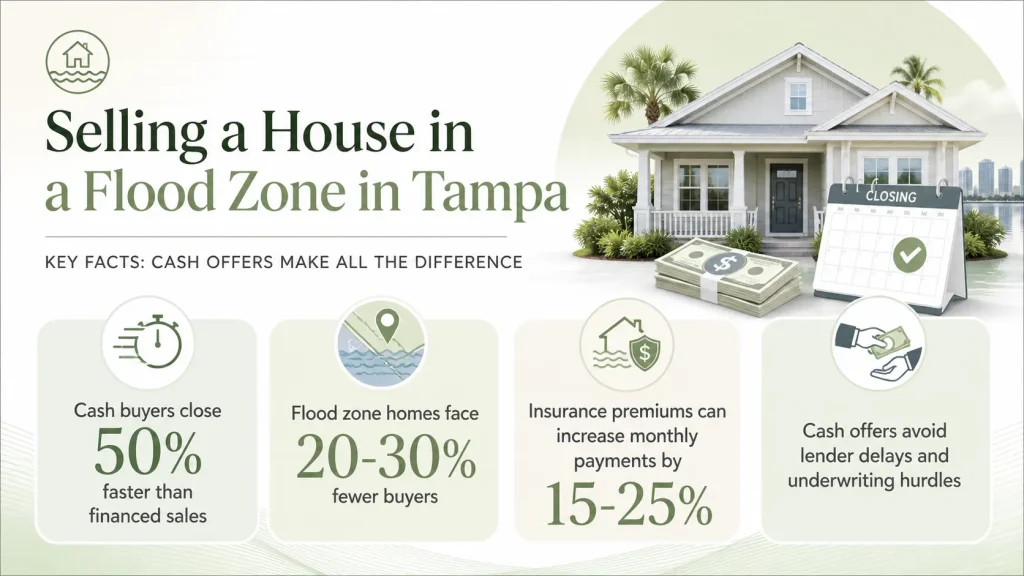
• Cash buyers skip lender delays entirely, offering a faster, more certain close.
• Appraisers and underwriters weigh flood risk into their valuations and conditions.
Imagine a South Tampa homeowner who accepts a strong financed offer, only for the buyer’s updated flood insurance quote to come in much higher than expected. The lender balks, the loan falls apart, and everyone is back to square one. That’s why some owners choose a cash buyer instead — trading a bit of upside for certainty and speed.
Selling a flood-zone house in Tampa usually means playing by a slightly different rulebook than a standard sale. You’ll want to understand your zone, share the right information, price with risk in mind, and plan for financing hurdles before you ever put up a sign.
• Confirm your exact flood zone and elevation so you can answer questions without guessing.
• Get clear on what flood-related information buyers typically expect you to share.
• Think through pricing and time on market with flood risk factored in.
• Plan for financing hurdles that can derail financed buyers late in the process.
• Decide how much prep work makes sense before comparing your selling options.
Start by confirming your exact FEMA flood zone before listing. Search your address on the FEMA Flood Map Service Center to see your official designation. FEMA also explains flood maps and base flood elevation in plain language, which helps when buyers or lenders ask technical questions.
| Zone | Risk Level | What It Means for Sellers |
| AE | High risk | Base flood elevation (BFE) is defined; flood insurance is typically required by lenders |
| VE | Highest risk | Coastal zone with wave action; insurance premiums are usually higher |
| X | Lower risk | Minimal flood hazard, though insurance may still be recommended |
An elevation certificate shows how your home’s floor height compares to the base flood elevation. Homes above BFE often qualify for lower premiums. Homes below it may face higher insurance costs and buyer hesitation, so sharing this document early builds trust.
• Flood maps show the odds of flooding in a given year for your parcel.
• Base Flood Elevation (BFE) marks the expected water height in a major flood event.
• Elevation certificates compare your home’s floor height to that expected water level.
You don’t need to become a flood engineer — you just need enough knowledge to answer buyer questions and share documents when asked. A clear grasp of your zone turns a confusing map into a straightforward part of your listing story rather than a deal-killing mystery.
Buyers in Tampa flood zones aren’t just buying a house — they’re buying the risk profile tied to your elevation, map label, and flood history. The more prepared you are to explain that profile, the more confidence you build with serious, qualified buyers.
Think about two Tampa examples. A low-lying block near the bay in an AE or VE zone with homes at or below BFE tends to see higher insurance quotes and more buyer caution. A slightly more inland neighborhood that still sits in a flood zone, but with homes higher than BFE, often sees more manageable premiums and steadier buyer interest.
• VE zones carry coastal wave-action risk on top of standard flood exposure.
• Higher elevation relative to BFE generally supports lower insurance premiums.
• Inland flood zones can still require insurance, but quotes are often steadier.
Florida sellers should disclose known material issues, including past water intrusion and damage. This isn’t legal advice — confirm specific requirements with a real estate attorney or closing professional. Standard disclosure forms typically ask about roof leaks, drainage problems, and storm damage. Buyers’ agents often follow up about flood insurance claims and repairs.
Any specific statute numbers, bill references, or legal requirements you plan to cite should be verified with an attorney before publishing or relying on them in writing. Rules and forms can change from year to year, so double-check before your listing goes live.
• Past flooding — when it happened, how deep, and how long water sat.
• Repairs and remediation — contractor reports, receipts, and remediation records.
• Insurance history — any flood-related claims or disaster assistance received.
• Mitigation work — flood vents, elevated mechanicals, or drainage upgrades.
This information usually surfaces in three places: the seller disclosure form early on, follow-up conversations after inspections, and lender or insurer questions during underwriting. Being upfront rarely kills a deal — hiding it can cause buyers to walk after inspectors find old water lines or mold.
Picture two similar Tampa houses in a flood-prone area. One owner gives vague answers and hopes the inspector misses old water lines; the buyer gets alarmed and walks. The other has receipts and a clear explanation of repairs, and the buyer negotiates but stays in the deal.
Transparency doesn’t guarantee your asking price, but it usually means a smoother closing and fewer surprises. Buyers and their agents generally respect sellers who organize their paperwork ahead of time rather than scrambling once questions come up during inspection.
Flood-zone status can affect price and time on market, but it isn’t the only factor. Location, condition, age, and mitigation still matter enormously. A desirable waterfront home may still draw strong offers despite flood risk. A non-waterfront home with repeat claims may need a sharper price to move.
• Buyer anxiety — some buyers avoid flood zones altogether, shrinking your pool.
• Ongoing costs — higher insurance premiums affect what buyers can afford monthly.
• Deal friction — appraisers and lenders add caution, which can slow closings.
Compare offers by net proceeds, not just the sticker price. A higher financed offer with repair demands and long underwriting can net less than a lower, faster cash offer once you factor in carrying costs and closing fees. Price is about what survives inspections and underwriting, not just what’s written on the first page of the contract.
To set a realistic price, look at similar non-flood-zone homes first, then compare your insurance costs and mitigation against theirs. Decide whether you’d rather price aggressively for a faster sale or hold firmer and expect more negotiation tied to insurance and inspections.
• Check recent sales of comparable non-flood-zone homes in your neighborhood.
• Note whether your premiums, elevation, or mitigation differ from those comps.
• Decide your trade-off between a faster sale and a higher asking price.
Flood insurance can make or break a financed sale. Lenders often require coverage for homes in higher-risk FEMA zones, and premiums are added to the buyer’s monthly payment. If costs push debt-to-income ratios too high, loans get denied or reduced late in the process. Many buyers rely on the National Flood Insurance Program for coverage, while others explore private flood insurance.
• Lenders may request proof of a flood insurance quote before final approval.
• Underwriters sometimes ask for an elevation certificate, which can delay closing.
• Updated insurance quotes late in the process can cause financed deals to collapse.
• Sellers can offer to cover part of a buyer’s first-year premium as a concession.
• Sharing realistic insurance expectations upfront helps serious buyers avoid late surprises.
A true cash buyer skips this entire process. There’s no lender approval, no debt-to-income math, and no insurance-driven loan denial. That’s why cash offers can feel like a relief for sellers tired of financing drama derailing a deal at the finish line.
Whether an existing flood policy can be assumed by a buyer, or a new one must be written, depends on the insurer, so confirm those details directly with the insurance company. Having your current declarations page or a recent quote ready saves time when serious buyers start asking questions.

You don’t need to renovate the entire house before listing. Focus on basics: gather documentation, handle simple maintenance, and fix anything that raises safety concerns. Skip expensive upgrades that won’t pay off in flood-prone areas — buyers care more about honesty and readiness than a showpiece renovation.
• Gather documents — elevation certificate, insurance policy, past claims, and repair receipts.
• Handle maintenance — clean gutters, check drainage, and test sump pumps.
• Fix confidence killers — stained drywall, warped trim, or musty odors from past water damage.
• Explain your history — be ready to describe what happened and what you fixed. See FEMA flood mitigation guidance for improvement ideas.
Fix the confidence killers, not every cosmetic flaw. Buyers in Tampa flood zones will overlook dated finishes, but obvious water damage, warped trim, or lingering musty odors can scare off even flexible buyers. A good rule of thumb: address anything that makes buyers question whether the home is safe before chasing fancy upgrades.
If you’re out of time or budget, you can still sell as-is and let buyers factor visible damage into their offer, or work with a local cash buyer who handles repairs and mitigation themselves. Once your documents and basic maintenance are handled, it’s time to weigh your selling path.
| Path | Repair Cost | Time to Close | Lender/Insurance Risk | Stress Level |
| Agent-listed MLS | Higher | Longer | Higher | Highest |
| FSBO | Similar to MLS | Similar to MLS | Similar to MLS | High |
| Cash homebuyer | Often lower | Faster | Lower | Lower |
Compare offers by what actually lands in your pocket, not the first number on paper. A local cash buyer purchases as-is, skips lender approval, and prices flood risk into the offer upfront — often the cleaner choice for storm-worn homes needing repairs.
Think about an inherited South Tampa bungalow that has flooded more than once and needs work. A traditional listing might mean repairs, showings during hurricane season, and buyers who get nervous after seeing insurance quotes. A cash buyer may offer less on paper but close with far fewer moving parts.
Flood-zone status doesn’t affect every property equally. Some homes stay attractive despite the risk; others struggle unless the price reflects the baggage. Waterfront homes, newer construction, and documented mitigation tend to hold buyer interest even with flood-zone labels attached.
| Still Attracts Buyers | Tends to Struggle |
| True waterfront or water-view homes | Non-waterfront homes with repeat flooding |
| Newer, storm-ready construction | Very high or climbing insurance premiums |
| Documented mitigation upgrades | Plenty of similar inventory outside the flood zone |
| Popular, high-demand neighborhoods | Homes with multiple past insurance claims |
Think of an older block near a Tampa waterfront promenade that’s charming but low-lying. Buyers still line up because they want the location badly enough, especially with mitigation in place. Compare that to an inland street without waterfront lifestyle that still floods; buyers there tend to be less forgiving.
Sometimes the decision isn’t about money at all. Many owners simply grow tired of tracking storms, sandbagging, and rising premium notices every season. If that’s you, a cash sale can hand off that burden immediately and let you move on before the next hurricane season.
A genuine local cash buyer doesn’t need a lender’s green light, so there’s no debt-to-income math or underwriter second-guessing your flood insurance. Someone who buys Tampa flood-zone homes regularly understands older Florida construction and can typically walk the property, review your documents, and make an offer without a lengthy repair list first.
• No major repair project required before listing.
• No waiting on a lender to approve flood-zone risk.
• No repair negotiations over every item tied to past flooding.
• No agent commissions cutting into your net proceeds.
If you’re ready for a simpler exit, reach out to The Best Cash Homebuyer for a no-obligation cash offer on your Tampa-area property — no repairs, no lender delays, and no drawn-out negotiations over past flood damage.
Yes — Florida sellers should disclose known flood-related issues, including past water intrusion and damage. Confirm exact requirements with a real estate agent or attorney, since disclosure forms and specific rules can change over time.
Yes. Speed depends on price, documentation, and financing. A local cash buyer often closes faster than a traditional financed sale because there’s no lender underwriting involved.
Many do, but high or uncertain insurance costs can push debt-to-income ratios too high, causing lenders to deny loans or reduce amounts late in the underwriting process.
Collect your elevation certificate, current flood insurance quote, past claims records, and repair or remediation receipts. This builds buyer trust and speeds up underwriting.
Often, yes — especially for homes with repeat flooding, big repair needs, or tight timelines. Newer, well-mitigated homes in high-demand areas may still perform well on the open market with a traditional listing.
Usually not. Most cash buyers purchase as-is and factor disclosed damage into their offer, though you should still share what happened honestly and provide any records or repair receipts you have.
Rarely. Serious investors buy in flood zones regularly and focus on whether the numbers work, not on avoiding the flood-zone label itself.
