
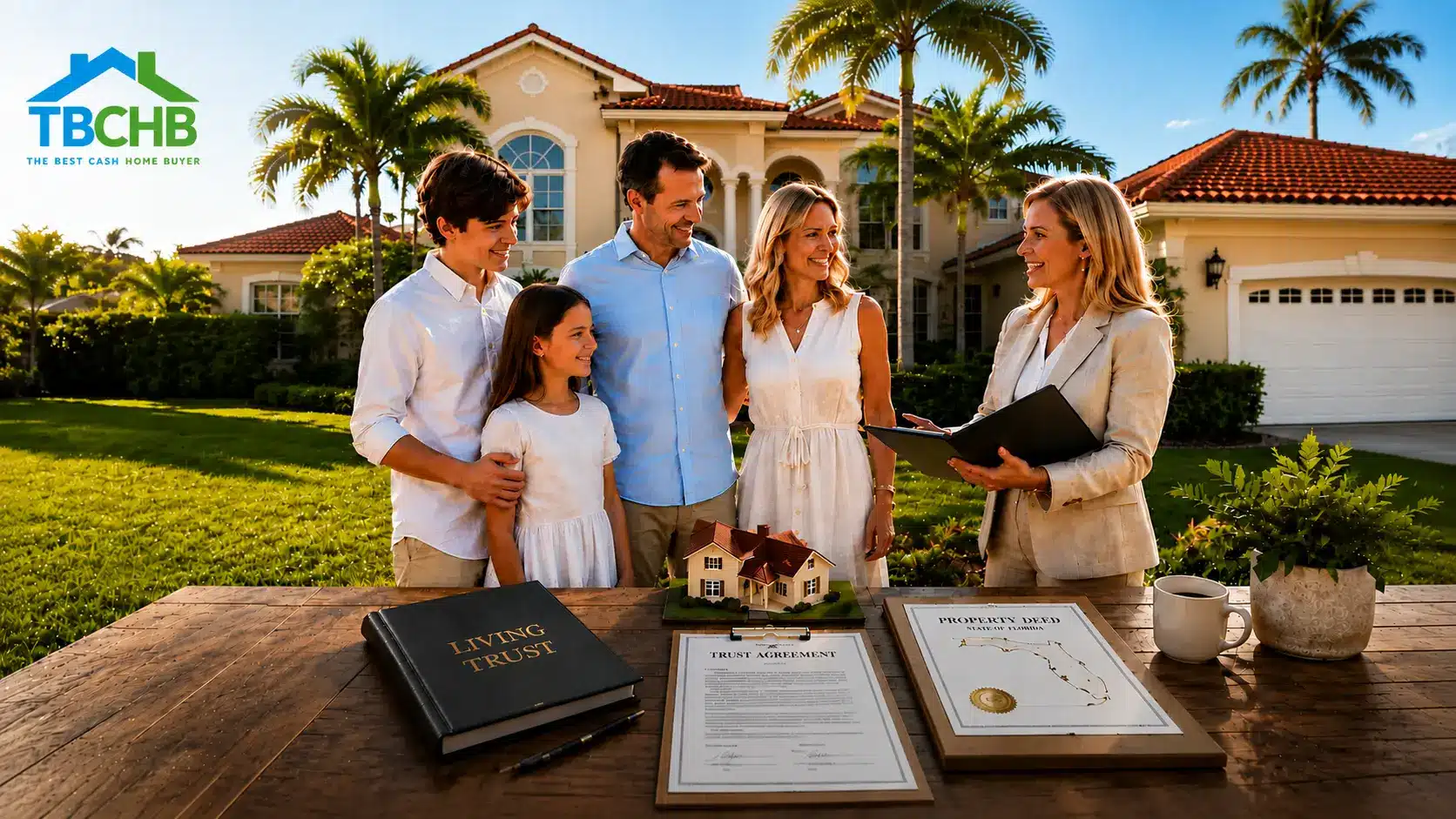
If you’re looking into this, you probably have one real question on your mind: will this help my family avoid probate, and what happens to the house later? That’s the heart of it.
Putting your home into a trust means the deed gets retitled in the name of the trust instead of your own name. You still live there, pay the bills, and call the shots day to day. But on paper, the trust owns the house, and that one change can save your family a lot of court time, paperwork, and stress down the road.
Florida has its own rules here for house in trust, especially around homestead property, and they’re different from what a lot of other states require. Florida trusts fall under Chapter 736 of the Florida Statutes, and because your home is likely homestead property, there are a few extra layers to think through. This guide walks through how it all works, what it costs, where people trip up, and what to do if the trust eventually calls for selling the house.
And if that’s the road you’re on, a cash sale can make things a lot simpler when there’s no will, repairs to deal with, or family members trying to coordinate from different states (a situation we also cover in our guide to selling a house in probate in Florida). We’ll get to that.
Everything here is general, educational information, not legal or tax advice. Your situation is unique enough that it deserves a real conversation with a Florida estate-planning attorney.
In plain terms: you create a trust document, then you (or your attorney) prepare a new deed that moves the property from your name into the name of the trust. You’re usually the trustee while you’re alive, so nothing about your daily life changes. You still own the house in every practical sense; it’s just that the legal paperwork says “trust” instead of your name.
Florida law makes trusts revocable by default unless the trust document says otherwise (under F.S. §736.0602), meaning you can change your mind, update the terms, or undo the whole thing while you’re alive and of sound mind. You name a successor trustee, often a spouse, adult child, or trusted professional, who takes over if you become unable to manage things yourself or after you pass away.

The biggest reason people do this is to give family a clearer, more private path when you pass away. When a house is in your name alone, it usually has to go through Florida probate, a public, court-supervised process that takes time and typically requires an attorney.
A properly set-up trust skips most of that. Since the trust already owns the home, there’s no need for a probate court to transfer it. Your successor trustee simply steps in and follows the instructions you left behind, often with very little court involvement.
It also helps if you become incapacitated. Instead of your family having to go to court for guardianship, your successor trustee already has the legal authority to manage the house for you.
This is also a good moment to mention something worth keeping in the back of your mind: if your family or your successor trustee eventually decides the house should be sold, having it cleanly titled in the trust tends to make that sale go a lot smoother, especially if a cash buyer is involved and speed matters.
Trust isn’t the only tool, either. Depending on your situation, a ladybird deed, beneficiary designations, or even a simple will might do the job just as well. Worth discussing with an attorney.
For most homeowners, life looks exactly the same after the house goes into a trust. You still live there, pay the mortgage, maintain the yard, and make your own decisions. You’re the trustee, so you’re still in the driver’s seat.
The one wrinkle is homestead protection. Florida treats your home’s homestead status a bit differently than other states, and the rules follow the house even after it’s in a trust. The short version: a properly drafted trust can usually preserve your homestead tax exemption (under F.S. §196.031), and it should respect the rule (under F.S. §732.4015) that you can’t leave your homestead to just anyone if you have a surviving spouse or minor children. That second part trips people up more than anything else, so we’ll come back to it.
Here’s the part people miss: creating the trust document is only step one. The trust doesn’t actually control your home until the deed is transferred into it. This step is called “funding” the trust, and skipping it is, by far, the most common and costly mistake homeowners make.
If you still have a mortgage, talk to your lender before recording anything. Many mortgages include a due-on-sale clause, and policies vary by lender (our guide on selling a house with a mortgage in Florida covers more on how outstanding loans factor into a sale). And one more thing worth keeping in mind: if the trust ever directs the home to be sold, clean and accurate paperwork from this step makes that future sale a lot easier, especially with a cash buyer who can move quickly without waiting on a long closing process.
Here’s the trade-off in plain English: setting up a trust costs money upfront, but it can save your family time, stress, and probate costs later.
Keep in mind, putting a house in a trust doesn’t make the regular costs of owning it disappear. Property taxes, insurance, HOA dues, and repairs are all still your responsibility (or your trustee’s, later on). If the home ever sits vacant or needs work, those carrying costs add up fast, which is one more reason families sometimes choose a quick, as-is cash sale instead of holding onto a property that needs attention nobody has time for.
By far the most common mistake: people create the trust document but never actually transfer the deed. The trust exists on paper, but the house is still legally in their name, so it goes through probate anyway. If you remember nothing else from this article, remember that funding the trust is the whole point.
Other common missteps:
One more mistake worth flagging, especially for families managing a parent’s estate: waiting too long to deal with a vacant or repair-heavy property once it’s time to sell. An empty house racks up insurance concerns, maintenance issues, and carrying costs every month it sits unsold. The longer it waits, the more it costs.
Probate is the court-supervised process for settling someone’s estate after they pass away: gathering assets, paying debts, and distributing what’s left to heirs, all under a judge’s oversight.
A properly funded trust lets your successor trustee skip most of that and manage or distribute the house directly under the trust’s instructions. That can spare your family weeks of uncertainty. But here’s the catch: the trust only avoids probate if the deed was actually moved into it before you passed away. If the deed still shows your name, the house goes through probate no matter what the trust document says.
And if the goal, after death, is ultimately to sell the house, this is exactly where a cash buyer can help. Less time spent prepping the home for showings, fewer people involved in approving repairs or pricing, and a faster path to closing while everyone is still sorting out the rest of the estate.
Trusts are useful, but they’re not magic, and they’re not free. A few honest things to weigh (the Florida Bar’s consumer pamphlet on wills and estate planning is a solid plain-language starting point if you want to read further):
Not everything belongs in a trust, either. Retirement accounts, for example, usually pass through beneficiary designations, and folding them into a trust can create tax headaches you didn’t need. A good attorney or CPA can help you sort out what goes where.
If the trust has already directed that the house be sold, or your family has simply decided that’s the right move, a traditional listing isn’t always the easiest path, especially when:
In these situations, an as-is cash sale tends to be the simpler route. There’s no need to fix anything up, no need to clean the place out before listing it, and no agent commissions eating into what the family receives. Closing can also happen on a timeline that works for everyone, rather than waiting on a buyer’s financing or a long chain of approvals. Take a look at how our process works to see what that looks like from start to finish.
The Best Cash Home Buyer works with trustees and families across Florida in exactly this situation: a house in a trust that’s ready to be sold, with no patience left for repairs, cleanout, or the back-and-forth of a traditional sale.
Who pays the property tax if a house in trust?
Property taxes don’t go away just because the home is in a trust. Usually, the trustee or whoever’s living in the house pays the bill, and the homestead exemption can still apply if it’s set up correctly. Check with your county property appraiser to confirm.
What are the downsides of putting a house in a trust in Florida?
Upfront legal and recording costs, the need for careful and current drafting, and a few Florida-specific homestead rules that can cause problems if they’re overlooked.
What should and shouldn’t go into a Florida house trust?
Your primary home is a common candidate. Retirement accounts and life insurance are usually better handled through beneficiary designations rather than folded into a trust, since that can trigger tax issues. Talk to a Florida estate-planning attorney for guidance specific to your situation.
What’s the real difference between owning a home outright versus owning it through a trust?
Owning it outright means the deed is in your name, and it typically goes through probate when you pass away. With a trust, the deed is in the trust’s name, the home can pass according to the trust’s instructions without formal probate, and a successor trustee can step in if you’re ever incapacitated.
Can a trustee sell a house that’s in a trust for cash?
Yes. If the trust gives the trustee authority to sell the property, and most do, the trustee can sell it just like any other owner, including to a cash buyer. This is often the simplest route when the trust calls for a sale and the family wants to avoid the cost and hassle of repairs, listings, and showings. See how our cash-offer process works for the trustee’s side of a typical sale.
Does putting a house in a trust avoid probate completely?
A properly drafted and fully funded trust can usually keep a home out of formal probate. That said, some court involvement is still possible, for example, if someone contests the trust, and Florida’s homestead rules apply no matter how the house is titled.
Putting your home in a trust is one of the most effective ways to plan for what happens to it down the road, whether that’s because of incapacity or after you’re gone. The details matter: the trust has to actually be funded, the deed has to be correct, and Florida’s homestead rules need to be respected from the start.
And if your trust eventually calls for selling the house, whether to divide proceeds among heirs, simplify a complicated estate, or because the property no longer fits the family’s needs, The Best Cash Home Buyer offers a fast, as-is option anywhere in Florida. No repairs, no cleanout, no commissions, and a closing timeline built around your family, not a buyer’s financing.
Take a look at how it works, browse our FAQ, or reach out today for a no-obligation cash offer. We don’t provide legal or tax advice, but when the trust points toward a sale, we’re glad to make that part of the process as simple as possible.
