
You walk up to your front door in Hillsborough County and find a bright notice taped to the glass. It mentions code violations, deadlines, and possibly fines, right when money already feels tight.
I’ve sat at many kitchen tables around Tampa Bay with owners in that exact spot. They worry that a notice about tall grass or a damaged porch is the first step toward losing the house.
Most owners I meet are not careless. They are usually juggling one of these:
Here’s the good news: Hillsborough County code enforcement exists to get properties safe and compliant, not to punish struggling owners. This guide explains how the process works, what fines and liens mean, and when selling as-is makes sense.
Hillsborough County Code Enforcement enforces property maintenance, land use, and basic safety codes in unincorporated parts of the county. Cities such as Tampa, Temple Terrace, and Plant City generally run their own programs. Check which agency sent your notice.
Officers are not police, and they do not make arrests. They document conditions, explain what needs fixing, and follow up until the property complies. Most residential cases begin when a neighbor or passerby files a report, so the process is largely complaint-driven.
The county’s reporting categories show how broad the codes are. Housing standards, foreclosure registration, and watering rules all appear alongside the everyday yard issues.
| Violation category | Typical examples | Why the county cares |
| Yard conditions | Overgrown grass, trash piles, junk, inoperable vehicles | Pests, blight, and neighborhood property values |
| Structural safety | Sagging porches, broken windows, unsafe sheds, condemned structures | Injury and collapse risk |
| Pools and water | Green or unfenced pools, standing water | Drowning risk and mosquitoes |
| Permits and zoning | Unpermitted construction, fence problems, illegal dumping | Safety and land-use rules |
| Abandoned property | Vacant homes that nobody maintains | Blight, break-ins, and decline |
As someone who buys problem properties across Tampa Bay, I see both sides. These rules keep neighborhoods safe, yet one notice can feel like the last straw for a struggling owner. Code enforcement is about getting a property safe again, not labeling you a bad homeowner.
• Inherited homes: A vacant house sits with overgrown landscaping and leftover junk. Heirs often live out of state and never see the first notice.
• Rentals: A tenant fills the yard with clutter while the owner lives far away. Our Florida eviction process guide covers that side of the problem.
• Fixed-income owners: A longtime homeowner slowly falls behind on repairs, and a porch or shed starts failing. Mowing is affordable, but a new roof is not.
• HOA overlap: Your association enforces its own rules, so you can receive both letters. See selling a house with HOA violations in Florida for that scenario.
Most cases follow a predictable ladder from complaint to resolution. Think of it as a path toward compliance, not a trap.
Each rung gives you a chance to fix the problem before the next one begins. The table below shows what happens at every stage and how to respond.
| Stage | What happens | Your best move |
| 1. Complaint | A resident or agency reports a possible violation. | Stay calm, because this is routine. |
| 2. Inspection | An officer documents conditions with notes and photos. | Record the officer’s name and contact details. |
| 3. Notice | You receive a written notice with violations and a compliance deadline. | Calendar every date immediately. |
| 4. Reinspection | The officer rechecks after the deadline passes. | Send dated before-and-after photos. |
| 5. Hearing | Unresolved cases can go to the Code Enforcement Board or a special magistrate. | Consider talking with an attorney. |
| 6. Fines or lien | Fines can accrue, and unpaid amounts can become a lien. | Ask about settlement and payoff options. |
In most cases, Florida Statute 162.06 requires officers to give you a reasonable time to correct a violation. Repeat violations can skip that grace period.
If the property sells before a hearing, the proceeding continues against the property. The new owner gets reasonable time to correct the violation.
Your notice sets the real deadline, so follow it instead of assumptions. If you cannot finish in time, ask the officer about extensions before the date passes.
• Keep every notice, letter, and email in one folder.
• Take dated photos as you make progress.
• Write down the officer’s name, the date, and any advice given.
• Save receipts from contractors, dump fees, and supplies as proof of effort.
Residents can report problems through the county’s online form or by calling Code Enforcement at (813) 274-6600. Hillsborough County’s reporting page lists the categories, from overgrown conditions to unsafe pools.
Hillsborough County does not accept anonymous code complaints under state law, effective 2021. Reporters must provide a name and address, which becomes a public record.
Knowing this helps you see a complaint as routine paperwork, not a personal attack. It also discourages frivolous disputes, because someone must stand behind each report.
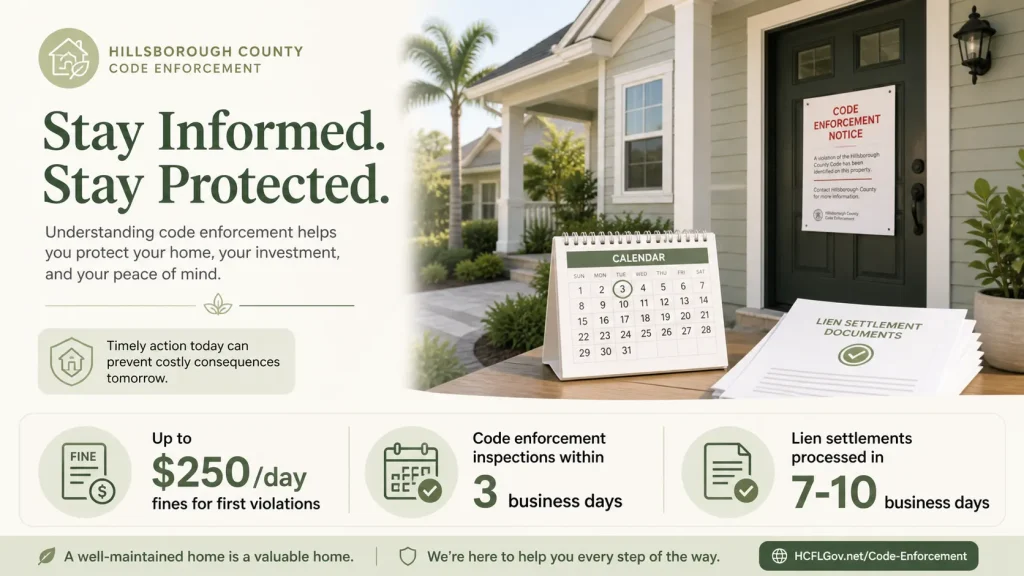
The county says it inspects reported abandoned properties within three business days.
Once a report is accepted, the system moves forward. A case opens, an officer is assigned, and an inspection joins the queue. If you are the property owner, the earlier sections show what comes next.
Fines generally start only after a compliance deadline passes and the violation remains. They can keep accruing daily until you fix the problem or a hearing officer rules otherwise.
A code enforcement lien is a legal claim recorded against the property, not your credit file. It appears in the title search and usually must be resolved before a sale closes.
• Title companies flag it during any sale or refinance.
• Mortgage lenders typically require payoff before funding a loan.
• Balances can grow while you wait, adding stress and cost.
| Fine type | Florida baseline cap |
| First violation | Up to $250 per day |
| Repeat violation | Up to $500 per day |
| Irreparable or irreversible violation | Up to $5,000 per violation |
| Higher caps with a qualifying local ordinance | Up to $1,000 per day, $5,000 per day (repeat), or $15,000 (irreparable) |
Those figures are ceilings, not predictions. They come from Florida Statute 162.09, and the board may reduce a fine. Your hearing order sets the actual amount.
Here is a realistic scenario. An owner ignores notices about an unsafe back porch and a junk-filled yard. Months pass, fines build, and the county records a lien. The owner only learns about it when a buyer’s title company flags it.
• Submit a lien settlement application to request a reduced fine.
• The property must be in compliance before a release or settlement can occur.
• Homesteaded properties may qualify for hardship consideration.
• Responses typically arrive within 7 to 10 business days.
Mitigation is never guaranteed, so treat settlement as an option rather than a plan. Confirm current requirements with the county before relying on it.
Officers usually inspect from the street, sidewalks, and other lawful vantage points. A quick look and a conversation at the front door is typical. Most visits simply confirm whether exterior problems have been corrected. Areas behind locked gates are a different matter.
Entering the inside of a home raises constitutional issues. It generally requires your consent or proper legal authority, such as a warrant. Fenced or locked areas also carry boundaries.
This guide is general information, not legal advice. If access becomes a real dispute, talk with a Florida attorney.
The first hour matters more than it feels like. A calm, organized response often keeps a small problem small. Even simple steps, like mowing and clearing trash, can ease pressure.
Here is the sequence I walk Hillsborough County homeowners through when that first notice arrives:
• Read closely: Mark every violation and every deadline on a calendar.
• Document everything: Walk the property and take date-stamped photos.
• Sort your repairs: Split cheap tasks like mowing and trash from big items like roofs and porches.
• Call the officer: Ask what compliance looks like and write down the answer.
• Start easy fixes: Visible progress shows good faith and can ease pressure.
• Ask about more time: Request an extension in writing if you are making progress.
• Save the paper trail: Keep notices, receipts, and photos together in case a hearing follows.
• Which exact conditions must change to close the case?
• What is the current deadline, and can it be extended?
• Will the officer accept photos as proof of progress?
If your notice mentions a Code Enforcement Board or special magistrate hearing, the case is getting serious. Talk with an attorney who knows local code enforcement.
Some owners can handle mowing and junk removal but cannot afford a new roof or a rebuilt porch. In that situation, stabilize what you can and start weighing an as-is sale.
Storm damage often drives violations. Two of our guides cover this. See selling a house with a leaking roof and selling a house with an open insurance claim.
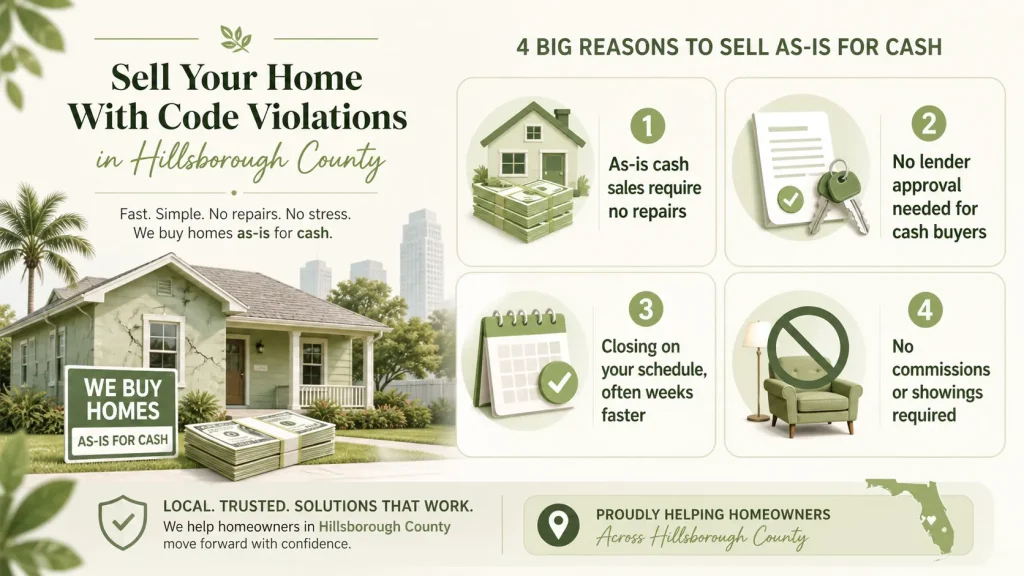
You can often sell a house with violations or recorded liens, but you must address them. Your options include repairing, paying or settling liens, or pricing the problems into the sale. Selling does not erase your duty to disclose known violations to the buyer.
Open violations make traditional buyers and their lenders nervous about safety, insurance, and future costs. Retail buyers using mortgages need an insurable property and clear title. Cash buyers skip lender approval, so they can buy as-is and handle liens through the title company at closing.
| Factor | Traditional sale | As-is cash sale |
| Repairs | Often required before the lender approves | None; the buyer prices them into the offer |
| Code liens | Must be resolved to close | Paid from sale proceeds through title |
| Commissions | Usually paid by the seller | None |
| Showings | Repeated, with inspections | Minimal |
| Timeline | Often weeks to months | Closing on your schedule |
Compare net proceeds, not sticker prices. Picture a Hillsborough County owner with an overgrown yard, a collapsing shed, and a pending hearing. A lower as-is offer can beat a higher retail price after repairs, commissions, and months of carrying costs. Mortgage, insurance, and utilities keep running while you wait.
Confirm lien payoff steps with the county and your title company early, because releases require compliance. Do not assume every lien shrinks or disappears. Own a vacant property? Read about selling a vacant house in Tampa.
• No lender to satisfy: Nobody insists that every violation be cleared before closing.
• Familiar problems: Overgrowth, rusted sheds, storm damage, and tired rentals are routine for us.
• Real as-is terms: We price repairs and risk into the offer instead of handing you a project.
• Title coordination: We work with the title company so lien payoffs come from closing proceeds.
The Best Cash Home Buyer is a St. Petersburg company, founded in 2022, that buys Florida homes as-is, including those with Hillsborough County code issues. The company reports buying more than $50,000,000 worth of houses.
For a no-pressure conversation about your code case, call (727) 291-9712 or email Offers@thebestcashhomebuyer.com. We will walk through what an as-is offer could look like for your property.
It enforces property maintenance, zoning, and safety codes in unincorporated areas. Officers inspect reported conditions, issue notices, and follow up until properties comply. The goal is voluntary compliance, not punishment, and cities like Tampa run separate programs.
No. Hillsborough County does not accept anonymous code complaints under state law, effective 2021. Reporters must provide a name and address, and that information can become a public record available through a request.
Your notice sets the deadline. Florida law generally requires a reasonable correction period, though repeat violations may not receive one. Contact the officer early, document your progress with photos, and ask how extension requests work before time runs out.
State law caps standard fines at $250 daily for first violations and $500 for repeats. Irreparable violations can reach $5,000, and qualifying ordinances can allow more. Your hearing order sets the actual amount owed.
Possibly. Hillsborough County accepts lien settlement applications, and homesteaded owners may qualify for hardship consideration. The property must be in compliance before a settlement or release, and responses typically take 7 to 10 business days.
Often, yes. Disclose the violations, and resolve any lien through closing proceeds. Cash buyers can purchase without lender approval. Confirm payoff details with the county and your title company before signing anything.
