
You log into your bank account and your Florida tenant is behind on rent — again. The mortgage, taxes, and insurance keep drafting on schedule while nothing hits your account. You are searching “Florida eviction process” at midnight trying to figure out what your options actually are.
This blog covers the major steps, realistic timelines, and real costs of the Florida eviction process for landlords. It also walks through a decision that more landlords face than you might expect: when to push forward with an eviction, when to negotiate a way out, and when selling the rental as-is to a cash buyer is the cleaner financial move.
Everything here is general education only — not legal advice.
The Florida eviction process is a court-supervised lawsuit, not a landlord simply telling a tenant to leave or changing the locks. A landlord must provide proper written notice, file a complaint in county court, and, if successful, rely on the sheriff to enforce the writ of possession. Self-help actions such as shutting off utilities or changing locks can expose landlords to damages and attorney fees.
Florida’s residential landlord-tenant rules are governed by Chapter 83 of the Florida Statutes. The required notice and process depend on the reason for eviction, such as nonpayment, a lease violation, or a holdover. The case is handled through the county where the property is located.
Understanding eviction as a formal legal process helps landlords weigh their options, including eviction, a negotiated move-out, or an as-is cash sale.
Typical eviction stages at a glance:
● Serve proper written notice — non-payment, lease violation, or end of tenancy.
● File an eviction complaint in the county court where the property is located.
● Tenant is served and given a deadline to respond; in non-payment cases may need to deposit rent into the court registry to contest.
● Judge reviews the case; mediation or hearings are scheduled if the tenant contests.
● Final judgment for possession is issued if the landlord prevails.
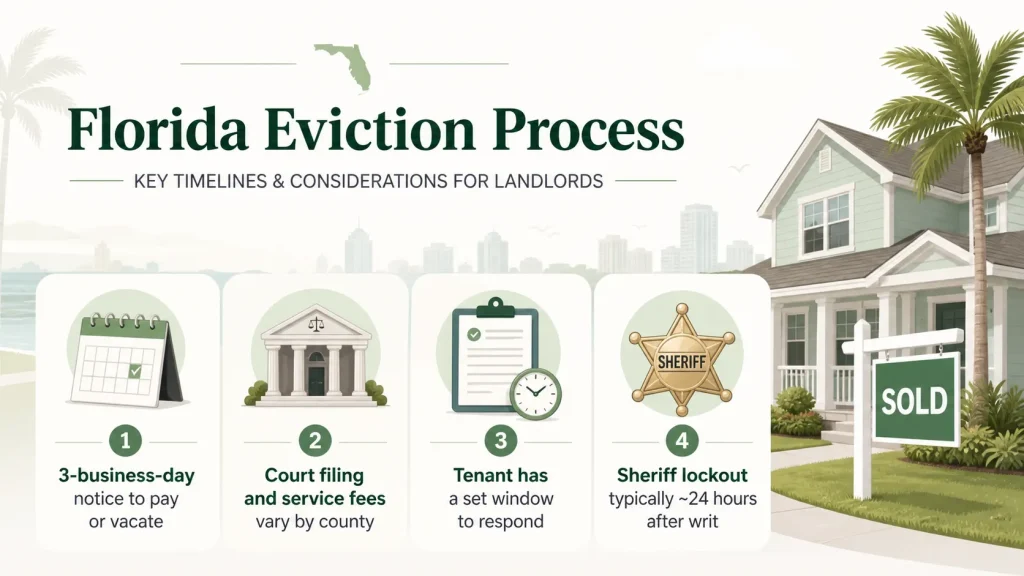
● Sheriff serves the writ of possession; tenant typically has ~24 hours before lockout is authorized.
Non-payment of rent is the most common eviction ground in Florida. The clock starts the moment rent is overdue and you decide not to wait another month hoping it resolves itself. Here is what the process typically looks like from first notice to lockout.
| Step | Action | Key details |
| 1 | 3-business-day notice to pay or vacate | Excludes weekends and court-observed legal holidays. Tenant pays rent in full or vacates. Florida law specifies exact wording — use a current form from your county clerk or a Florida attorney, not an old saved file. |
| 2 | File eviction complaint in county court | Orange County Clerk eviction page or your own county clerk for current forms, filing instructions, and fee schedules. Fees vary by county and change periodically. |
| 3 | Tenant is served; deadline to respond | Once served, the tenant has a set window to file an answer. In non-payment cases, a contesting tenant is usually required to deposit overdue rent into the court registry or risk losing the right to dispute the case. |
| 4 | Mediation or hearing if tenant contests | Bring the signed lease, a complete payment ledger, copies of every notice served and proof of delivery, and any supporting photos or documentation. Gaps in your paperwork can slow or sink the case. |
| 5 | Final judgment for possession | If the tenant does not respond or the judge rules for the landlord, the court enters a final judgment for possession. Timing from here depends on how quickly the clerk processes the judgment. |
| 6 | Writ of possession and sheriff lockout | Hillsborough County Clerk eviction information, tenants generally have ~24 hours after writ service before the sheriff authorizes removal of belongings and a lock change. Exact logistics vary by county and judge’s orders. |
Best case: the tenant pays in full during the notice window and no eviction is filed. Worst case: service problems, a contested tenant raising defenses, or a backlogged court calendar can stretch the process from a few weeks into several months. Every extra week is another cycle of mortgage, insurance, HOA, and taxes leaving your account with nothing coming in.
Some landlords in places like Pasco or Hernando County — where carrying costs on a second property are tight — reach the point where they start weighing whether riding out the court calendar is actually worth it compared to a clean exit.
Non-payment gets most of the attention, but it is far from the only reason Florida landlords file. Florida Law Help eviction resources cover the full range of grounds. Knowing the right grounds — and matching them to the right notice type — keeps a case from being dismissed on a technicality before it gets off the ground.
Common non-payment grounds and how they work:
● Serious lease violations. Unauthorized occupants, unapproved pets, significant property damage, or criminal activity on the property. The landlord typically gives a cure-or-quit notice: fix the problem within the required number of days or vacate.
● Unconditional quit notices. Repeated violations or severe misconduct — such as chronic damage or illegal activity — may allow a notice with no cure option. The tenant must vacate by the deadline with no chance to fix the issue.
● Holdover tenancy. The fixed-term lease expired or a month-to-month tenancy was properly terminated and the tenant simply stays. File as a holdover eviction case.
● Owner move-in or sale of property. Wanting to occupy the unit or sell the property is not a shortcut around the tenant’s rights. Notice rules and lease terms still apply in full, and a formal eviction may still be required if the tenant does not leave after proper notice.
The wording and timing for each notice type come from current Florida statutes and sometimes local court rules. Using an outdated template — even one that worked two years ago — can get a case tossed and force you to restart.
Florida draws a hard line between a lawful court-supervised eviction and an illegal self-help eviction. Landlords have the right to collect rent, enforce reasonable lease terms, and regain possession of their property — but only through proper notice and the court process.
The moment a landlord tries to skip the court and force a tenant out another way, they risk civil liability. Common self-help tactics that can trigger landlord liability include changing locks before a court-ordered writ, removing doors or windows, shutting off water or electricity, and harassing or threatening the tenant to pressure them to leave. These actions can result in the landlord owing the tenant damages and attorney fees.
Key tenant protections that show up most often in Florida eviction disputes:
● Right to proper written notice before any eviction action is taken.
● Protection from retaliatory evictions — for example, a landlord issuing a lease termination notice shortly after a tenant contacts code enforcement about a repair issue. Florida Law Help eviction resources explain how retaliation claims arise and what tenants can do.
● Protection from housing discrimination under federal and state fair housing laws.
Retaliation claims come up more often than landlords expect. If you issue a notice or file a case close in time to a tenant’s repair complaint, a code enforcement call, or a fair-housing inquiry, a judge may treat that timing as evidence of retaliation.
This section is general information only, not legal advice. If you are anywhere near a gray area on tenant rights, retaliation, or fair housing, call a Florida attorney or legal-aid office before acting.
Most landlords focus on the filing fee when they think about eviction costs. That is the smallest part. The table below covers the full cost picture. Official fees vary by county and change over time — always pull the current schedule from your county clerk before you file rather than relying on numbers from an online guide.
| Cost category | What it covers | What landlords often miss |
| Court filing fee | Filing the eviction complaint in county court. | Orange County Clerk or your own clerk’s site for the current schedule before filing. |
| Service of process | Having the complaint and summons formally served on the tenant. | Sheriff or private process server fees; your county clerk’s site lists current options and rates. |
| Sheriff’s writ of possession fee | Fee for the sheriff to serve and enforce the writ at the end of the case. | Check the current local schedule — do not guess based on what a landlord told you they paid years ago. |
| Attorney fees | Legal representation, especially for contested cases. | Many landlords hire counsel for anything beyond a simple uncontested filing. Fee structures vary widely. |
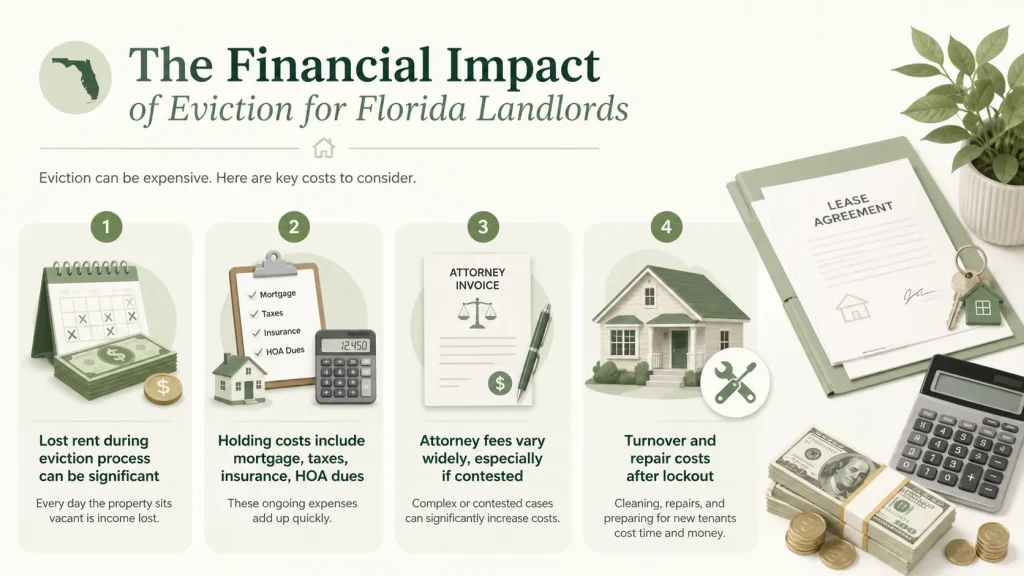
| Lost rent | Rent not collected during the notice period, filing, court process, and any vacancy after lockout. | Often the largest single hit — the property is costing you money every week rent is not coming in. |
| Holding costs | Mortgage, property insurance, taxes, utilities, and HOA dues while rent is not being paid. | These stack silently. A multi-month eviction can mean thousands in carrying costs on top of missed rent. |
| Turnover and repairs | Deep cleaning, trash haul-off, drywall, paint, flooring, and re-rent prep after the lockout. | Hard evictions often leave behind damage. Budget for at least basic repairs before you can re-rent. |
Run the full math before you decide what to do. Subtract missed rent, all carrying costs, attorney fees, and post-lockout repairs from whatever you expect to net from keeping the property. That real number — not the headline asking rent — is what you compare against other options like a negotiated move-out or an as-is cash sale.
After a difficult eviction cycle, most Florida landlords land at a fork in the road. Keep the property and push through, try to negotiate an exit with the tenant, or sell as-is and hand the whole situation to someone else. Here is how each path tends to play out and who it fits.
| Path | Best fit for… | Key trade-off |
| Pursue eviction and re-rent | Owners with cash reserves to cover 2–4 months of lost rent, a long-term hold plan, and a property in good condition in a strong rental market. | You absorb court timelines, legal costs, and turnover before income resumes. Works best when the property is genuinely worth holding long-term. |
| Negotiate with the tenant | Situations where the relationship has not fully broken down — tenant is willing to sign a move-out date or accept a cash-for-keys offer. | Faster than court and avoids an eviction on the tenant’s record. Get every term in a signed written agreement and have a Florida attorney review it if anything feels unclear. |
| Sell as-is to a cash buyer | Out-of-state owners, repeat eviction cycles on the same property, serious repair needs, foreclosure pressure, or landlords who are simply done with the stress. | You accept a discount off top retail price. In return, the buyer takes on the tenant situation, repairs, and any remaining court process — and you get a set closing date instead of an open-ended court calendar. |
Think net proceeds, not sticker price. A higher MLS offer can look great on paper until you subtract months of missed rent, holding costs, repair bills, agent commissions, and closing costs. A lower as-is cash offer with a fast, certain close can sometimes leave you in a similar or even better position once you run the full numbers.
Real Florida scenarios where the cash path tends to make sense: an inherited Pasco County rental with a non-paying family member and deferred maintenance; a St. Pete triplex with one chronic non-payer who has already been through one eviction; a Georgia-based owner managing a Tampa property by phone and dreading another round of out-of-state court dates. In all three cases, a buyer who prices in back rent, repairs, and the eviction timeline can offer a faster, cleaner exit. The Florida Bar consumer resources page is a good starting point if you need to find a Florida real estate attorney before making a decision.
The Best Cash Home Buyer works exclusively with property owners. But some people searching for “Florida eviction process” are tenants who just received a 3-day notice or court papers and are trying to understand what happens next. If that is you, your rights are real and timing matters.
Do not ignore a summons or complaint. Missing a court deadline — including the window to deposit rent into the court registry — can limit or eliminate your ability to contest the eviction. Get help as quickly as possible from one of these neutral resources:
● Florida Law Help — statewide legal-aid site with plain-English guides on evictions, tenant rights, how to respond to court papers, and local resources by county.
● Local legal-aid organizations — many counties offer free or reduced-cost legal help for income-qualifying tenants facing eviction.
● County clerk self-help centers — staff can walk you through forms and basic procedures, though they cannot give legal advice.
● Florida court self-help resources — the state court system provides standard landlord-tenant forms and process explanations online.
Nothing in this article is legal advice for tenants or landlords. Both sides deserve accurate information and a fair process — and both sides benefit from talking to a licensed Florida attorney about their specific situation before taking action.
Cash buyers do not need lender approval, appraisals, a vacant unit, or a finished repair list. A buyer like The Best Cash Home Buyer works with Florida rental properties every day — older homes, places with active or recent tenants, storm-damaged properties, and rentals with years of deferred maintenance. The offer prices the tenant situation, any back rent, and needed repairs into the number upfront, so you are not stuck trying to become a legal expert or a general contractor just to move on.
The Best Cash Home Buyer serves property owners across Florida, with deep roots in St. Petersburg and the greater Tampa Bay area. If you are ready for a clean exit from a problem rental, reach out for a no-obligation as-is cash offer and find out what that path actually looks like for your property.
What you skip with an as-is cash sale:
● Repair projects and contractor coordination before you can list.
● Waiting on lender or insurance approvals tied to the property’s condition or tenant status.
● Post-inspection renegotiations driven by the tenant situation or deferred maintenance.
● Agent commissions and seller-paid closing costs eating into your net.
● Open-ended carrying costs while you wait for a financed buyer to clear underwriting.
A landlord serves a 3-business-day notice, then files in county court if the tenant does not pay or vacate. If the landlord wins, the sheriff enforces a writ of possession. See Florida Law Help for a full plain-English overview of tenant and landlord rights.
Uncontested cases in lighter-docketed counties can move from notice to lockout in a few weeks. Contested cases, service delays, or heavy court backlogs can stretch the timeline to several months with no guaranteed endpoint.
A written notice giving the tenant three business days — excluding weekends and legal holidays — to pay all rent owed in full or vacate. Florida law specifies the exact wording. Use a current form from your county clerk or a Florida attorney; an outdated template can get the case dismissed.
No. Changing locks, removing doors, or cutting utilities without a court-ordered writ of possession is illegal in Florida. These self-help tactics can expose landlords to civil damages and attorney fees. All evictions require a formal court judgment.
Yes. You can sell the property as-is to a buyer willing to take on the tenant situation and price that risk into their offer. You trade some price for certainty: a known closing date instead of an open-ended court calendar.
Usually not. Most cash buyers purchase as-is with tenants in place and factor the repair work, back rent, and any eviction timeline into their offer. Be transparent about everything you know about the property and tenant situation.
Not typically. A cash buyer reviews the case status and any loan payoff. Their funds at closing can pay off the mortgage. The eviction either transfers to the new owner or is resolved through a closing agreement — consult a Florida attorney on legal strategy.
