

In Florida, homeowners insurance usually covers water damage that is sudden and accidental from inside the home, like a burst pipe or a washer hose that pops, but it generally does not cover floodwater from outside or long-term leaks, and every policy’s details are different. That yes-and-no answer is what makes this so stressful when you’re staring at wet drywall and ruined floors.
If you’re scared your claim will be denied or the check will be tiny, you’re not alone. In my work buying houses across Tampa Bay and greater Florida, I’ve seen owners deal with burst pipes, AC leaks, storm damage, and mold, only to find out their coverage has gaps.
In here, I’ll walk you through how Florida policies usually treat water damage, how flood and mold fit in, what to do right after a loss, and what your real options are if insurance doesn’t come close to covering the repairs. If your home has already taken on water, our breakdown of water damage repair costs in Florida is a good companion read for budgeting what’s ahead.
You just noticed a brown water stain spreading across your ceiling after a Florida thunderstorm, and you’re debating whether calling your insurer will bring help or a headache. In Florida, homeowners insurance typically covers water damage that is sudden and internal, caused by a covered peril like a burst pipe or appliance line, but it generally does not cover gradual leaks or flood damage from rising water, which requires separate flood insurance. According to the Insurance Information Institute, water damage and freezing are consistently among the top two causes of homeowners insurance claims nationwide, second only to wind and hail.
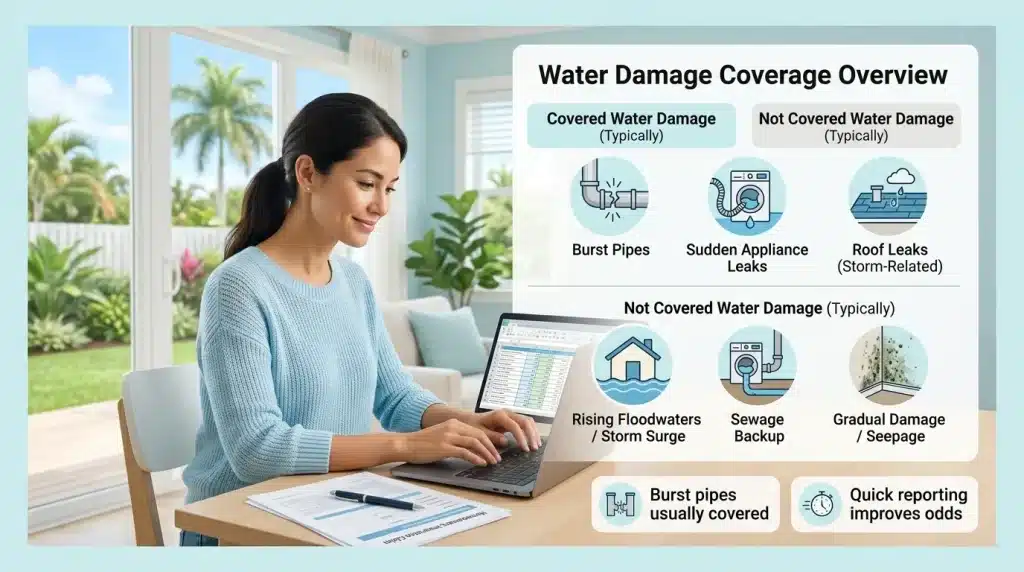
Most policies use “sudden and accidental” language for covered water damage, meaning the loss happened abruptly rather than slowly over weeks or months. A supply line that blows under a kitchen sink, a washing machine hose that pops while you’re at work, or an AC condensate line that suddenly overflows into a ceiling usually fit that internal, sudden-loss pattern. Slow drips and long-term seepage are where many Florida owners get tripped up, since insurers often treat ongoing issues as maintenance rather than a covered loss.
Often covered as water damage
Often not covered or only lightly covered
Even when a loss is covered, deductibles and policy limits shape what you actually receive, since a typical HO-3 policy sets separate limits for the dwelling and personal property, and any payout is reduced by your deductible. If repairs only slightly exceed your deductible, you may end up with a small check and a big repair bill, and if the insurer won’t do much, selling the house as-is becomes one option to compare against repairing and fighting over every line item.
You might be staring at a soggy ceiling or buckled flooring right now, trying to guess whether you’re in the covered camp or the denied camp. These Florida-style scenarios sort into three buckets: likely covered, likely not covered, and it depends, though your specific policy and insurer make the final call. The pattern that matters most is whether the damage came from a single, sudden internal event or built up slowly over time.
| Scenario | Likely Outcome | Why |
| Washing machine or dishwasher hose bursts | Likely covered | Sudden, internal water source, one-time event |
| AC condensate line suddenly clogs and overflows | Likely covered | Sudden internal loss, even with regular maintenance |
| Pipe bursts during a cold snap | Likely covered | Clear, sudden burst-pipe event |
| Slow roof leak stains a ceiling over months | Likely not covered | Treated as maintenance or wear and tear |
| Water seeps through a slab in a high water-table area | Likely not covered | Classified as groundwater seepage |
| Sewer or drain backup | Often not covered | Excluded without a specific endorsement |
| Storm surge or canal water rises into the home | Not covered by homeowners policy | Classified as flood, needs a separate policy |
| Wind-driven rain through a storm-damaged roof | Depends | May be covered as part of the storm loss |
Around Florida, two neighbors can have similar-looking damage but very different outcomes: one has a burst pipe that gets paid, the other has a slow leak abelled maintenance and gets denied. From the outside, both ceilings look bad; on paper, only one fits the sudden-and-accidental box, so clearly documenting a single event and reporting it quickly improves your odds.
A tropical system just rolled through, and one neighbor is getting a check for a burst pipe in the ceiling while another is told their garage full of bay water is flood and not covered. The key difference: standard Florida homeowners insurance usually covers sudden, internal water damage from things like burst pipes or storm-damaged roofs, but it generally does not cover flood damage from rising water outside the home, which requires a separate flood policy.
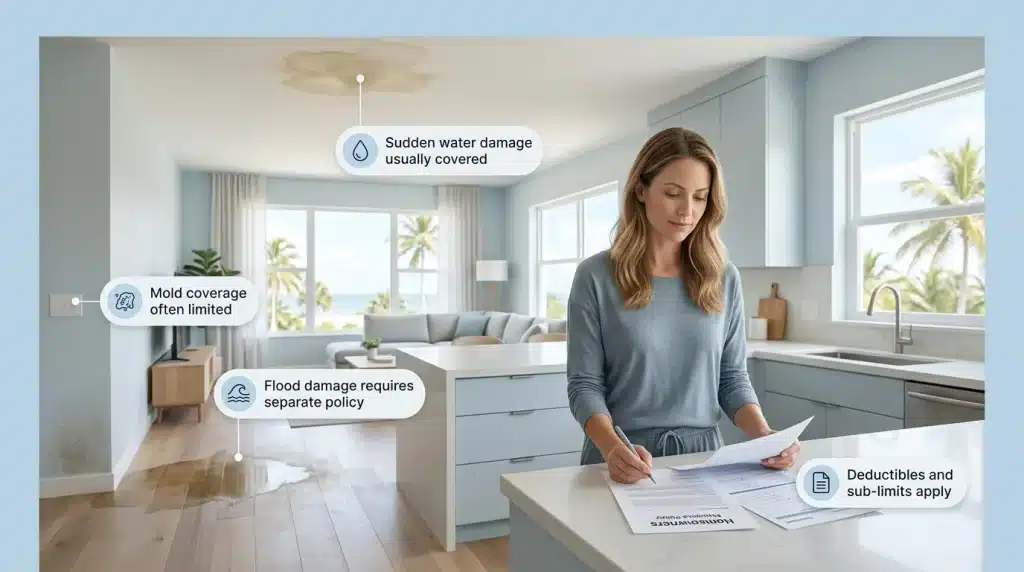
FEMA’s FloodSmart program defines a flood, in simple terms, as an excess of water on land that’s normally dry, and the National Association of Insurance Commissioners notes that flood coverage isn’t included in a standard homeowners policy at all — it has to be purchased separately.
| Water Damage (Homeowners Policy) | Flood (Separate Flood Policy) |
| Source: pipes, appliances, AC, roof leaks from a covered storm | Source: storm surge, rising rivers or canals, street runoff |
| Trigger: sudden, internal, one-time event | Trigger: rising water affecting large areas of land |
| Handled by: standard HO-3 homeowners policy | Handled by: NFIP or private flood insurance |
The National Flood Insurance Program describes a flood as water covering at least two acres of normally dry land or affecting two or more properties, often from rivers, lakes, storm surge, or heavy rainfall runoff. A simple shortcut: water from inside the house or from above is usually water damage; water that rises from the ground, street, canal, or bay is probably flood.
Coastal and low-lying neighborhoods around Tampa, St. Petersburg, Miami, and riverfront Jacksonville often sit in mapped flood zones where lenders require flood insurance — check St. Petersburg real estate market for more on this. Tightening flood compliance rules like the “FEMA 50% Rule” can force major rebuilding decisions once a home is classified as substantially damaged. Repeated flood or water claims can also make future insurance harder to get or more expensive. A cash buyer doesn’t rely on the same loan approval process as a bank-financed buyer, so prior claims can be evaluated up front instead of playing spoilsport later.
Maybe you mopped up a leak, ran the fans, and thought you were in the clear, then came home to a musty smell and dark spots creeping up the wall. In most policies, mold is treated as a result of water damage rather than a main covered peril, and it’s typically only covered when it stems from a sudden, covered water loss and fits within the policy’s mold limits or endorsements.
If a pipe bursts behind a wall and you report it quickly, resulting mold is sometimes covered, but often only up to a separate, much smaller mold sub-limit even when your dwelling limit is higher. Mold that builds up slowly from Florida humidity, or from a roof leak that’s been seeping for months, usually gets treated as a maintenance problem instead of a covered loss.
For DIY cleanup, the EPA’s mold cleanup guidance notes that a patch smaller than about 10 square feet (roughly 3 feet by 3 feet) can often be handled yourself with detergent and water, while anything larger generally calls for a professional. Even when insurance participates, mold cleanup is often messy, disruptive, and only partly paid for. If the house no longer feels healthy or affordable to repair, selling as-is is one option to compare before spending money on a cleanup project you may not want to take on.
It’s late at night, you’ve got a PDF of your policy open at the kitchen table, and every line you read feels like another way the insurer could say no. Instead of memorizing every clause, use a quick checklist to spot the big water and flood issues, then bring specific questions to your agent. An endorsement is an add-on that can add coverage, like sewer backup, while a sub-limit is a smaller cap inside your policy for a specific type of loss, such as mold, even if your main dwelling limit is much higher.
| Where to Look | What to Check |
| Declarations Page | Dwelling limit, personal property limit, deductibles, hurricane or named-storm deductible |
| Perils Insured Against | How water damage is defined, whether it specifies sudden and accidental |
| Exclusions | Flood, surface water, sewer backup, groundwater, seepage language |
| Endorsements or Riders | Sewer backup coverage, mold limits, special water or flood add-ons |
Build a short list of questions for your agent, such as whether you have any flood coverage, whether sewer backup needs an endorsement, what your mold sub-limits are, and whether prior claims could affect your renewal. Ask them to walk through how your policy would respond in a few what-if scenarios, since they deal with this fine print every day. Most owners only really understand their coverage after a bad event, so getting a handle on your gaps now puts you in a better position if you ever have to decide between repairing or selling.
You’re standing in wet carpet, mop in one hand and phone in the other, trying to decide if you should shut off the water, call for help, or start filming first. The first few hours after water damage are about staying safe, limiting damage, and protecting your claim.
Watch out for demolishing too much before the claim is documented, since tearing out walls without a clear plan from the adjuster can make it harder to show what was damaged. For large or complex claims, or when you suspect underpayment, some owners bring in a public adjuster or attorney to push back. Once the emergency is under control, you can decide whether it makes sense to live through months of repairs or look at other options like selling as-is.
You finally get the claim letter, flip to the check amount, and feel your stomach drop because it doesn’t come close to the contractor’s estimate, or it’s a straight denial. There isn’t a single average payout that means much for water damage, since numbers swing based on the size of the damaged area, the finishes, whether mold is a factor, temporary housing needs, and whether your policy pays replacement cost or actual cash value.
| Common Reason | What It Means for Your Payout |
| Labeled maintenance, not sudden | Adjuster ties damage to a slow leak or worn plumbing and applies exclusions |
| Cause is excluded | Flood, groundwater, or certain backups fall outside standard coverage |
| Sub-limits apply | Mold or similar caps chop down the payout even when the main loss is covered |
| Damage is near the deductible | Repairs cost close to the deductible, leaving little or no net payout |
| Late reporting or thin documentation | Weak evidence makes it easier for insurers to question what happened |
A pattern I see often: a small bathroom leak technically qualifies as covered, but once the deductible is applied, there’s very little left; a major pipe burst might look like it should lead to a big check, but mold sub-limits, named-storm deductibles, and line-by-line disputes chip away at the total. What matters isn’t the headline claim number but what you’re left with after deductibles and months of disruption.
When I sit with sellers across Tampa Bay and greater Florida, we often talk about net proceeds instead of top-line numbers, since the path that looks richest on paper isn’t always the one that puts the most cash and peace of mind in your pocket.
You’ve got a couple of contractor bids on the table, a disappointing insurance number, and your savings account pulled up on your phone. When insurance comes up short, most Florida homeowners end up choosing between a few main paths:
A true cash buyer doesn’t need lender approval or a clean insurance story to close. If your claim was denied, your deductible ate most of the payout, or the thought of months of repairs just feels like too much, selling as-is can be a straightforward way to step away from a water-damaged property. For owners who are out of time, short on repair money, or just done dealing with adjusters and contractors, having a local cash number on the table can make the whole situation feel a lot less overwhelming.
If you’re standing in a wet Florida house right now, trying to decode your policy and figure out if that claim letter will actually fix your problem, I know how heavy it all feels. Between sudden leaks, flood rules, mold limits, deductibles, and contractor bids, it can start to feel like every path is a trade you don’t really want to make.
If you reach the point where you’re just done with this house, my team at The Best Cash Home Buyer can give you a clear, simple alternative to compare. We buy houses in Florida for cash, directly, without listing on the MLS, and we’re based in St. Petersburg while buying across Tampa Bay and greater Florida.
You can reach us at (727) 291-9712 or through The Best Cash Home Buyer website to talk through your situation and get a no-pressure cash offer on your Florida home.
Does homeowners insurance cover water damage from a burst pipe in Florida?
Yes, most Florida homeowners policies cover sudden, accidental water damage from a burst pipe, since it’s treated as an internal event rather than gradual wear, though deductibles and dwelling limits still apply.
Is flood damage covered under a standard Florida homeowners policy?
No. Flood damage from storm surge, canals, or rising water is excluded from standard homeowners insurance and requires a separate flood policy through NFIP or a private flood insurer.
Does homeowners insurance cover mold caused by water damage?
Sometimes. Mold is usually covered only when it results from a sudden, covered water loss, and payouts are often capped by a separate, smaller mold sub-limit in your policy.
What should I do first after discovering water damage in my Florida home?
Turn off power and water safely, document everything with photos and video, contact your insurer promptly, and start basic mitigation like drying and running fans to limit further damage.
What can I do if my Florida water damage claim is denied or underpaid?
You can request a detailed denial explanation, consult a public adjuster or attorney, or, if repairs feel unaffordable, consider selling the home as-is to a cash buyer instead.
